Categories
August 2018

Day by Day Current Affairs (August 17, 2018) | MCQs for CSS, PMS, NTS

WELCOME TO CSS TIMES DAY BY  DAY CURRENT AFFAIRS, YOUR BEST SOURCE FOR UP-TO-DATE AND DAILY TOP CURRENT AFFAIRS 2018 FOR PREPARATION OF CSS, PMS, BANKING, NTS, RAILWAYS AND ALL COMPETITIVE EXAMS.  “DAY TO DAY CURRENT AFFAIRS” BASICALLY IS TOP 10 NEWS SUMMARY ON CURRENT HAPPENINGS OF NATIONAL AND INTERNATIONAL IMPORTANCE FOR ALL EXAMINATIONS

Categories
August 2018

Day by Day Current Affairs (August 16, 2018) | MCQs for CSS, PMS, NTS

WELCOME TO CSS TIMES DAY BY  DAY CURRENT AFFAIRS, YOUR BEST SOURCE FOR UP-TO-DATE AND DAILY TOP CURRENT AFFAIRS 2018 FOR PREPARATION OF CSS, PMS, BANKING, NTS, RAILWAYS AND ALL COMPETITIVE EXAMS.  “DAY TO DAY CURRENT AFFAIRS” BASICALLY IS TOP 10 NEWS SUMMARY ON CURRENT HAPPENINGS OF NATIONAL AND INTERNATIONAL IMPORTANCE FOR ALL EXAMINATIONS

Categories
August 2018

Day by Day Current Affairs (August 15, 2018) | MCQs for CSS, PMS, NTS

WELCOME TO CSS TIMES DAY BY  DAY CURRENT AFFAIRS, YOUR BEST SOURCE FOR UP-TO-DATE AND DAILY TOP CURRENT AFFAIRS 2018 FOR PREPARATION OF CSS, PMS, BANKING, NTS, RAILWAYS AND ALL COMPETITIVE EXAMS.  “DAY TO DAY CURRENT AFFAIRS” BASICALLY IS TOP 10 NEWS SUMMARY ON CURRENT HAPPENINGS OF NATIONAL AND INTERNATIONAL IMPORTANCE FOR ALL EXAMINATIONS

Categories
Articles Pakistani Newspapers

Pakistan – Challenge and Response (Tariq Osman Hyder)

[mks_button size=”small” title=”By: Tariq Osman Hyder” style=”squared” url=”” target=”_self” bg_color=”#59d600″ txt_color=”#FFFFFF” icon=”” icon_type=”” nofollow=”0″]

Pakistan’s 71st Independence anniversary is a time for looking back to see forward. The country is a prime example of the global historian Toynbee’s challenge and response theory. If the challenge facing a civilization, a country or a society is too great as in the artic, then the struggle to survive in the harsh climate leaves no room to develop. Conversely if there is hardly any challenge as in the South Seas where the weather is pleasant all year round and fruit and fish abundant the lack of challenge provides no spur to change. Progress comes out of the crucible of facing and overcoming challenges.

For Pakistan its very formation as a new country was a tremendous achievement. The Muslim community had to overcome the opposition of the ruling colonial power the British and the larger non-Muslim community, that too in a precipitate time frame not of its making, without the eight years interim period to prepare that it had accepted. But the Congress leaders rejected the Cripps plan because Pakistan would have eventually emerged larger in territory and because they wanted to ensure that as many Muslims as possible were forced to leave.

Once independent it made do with skeleton civil services, seven million traumatized refugees, no industrial base, a small ill-equipped military, withheld bank reserves, and with part of Muslim majority Kashmir which was its rightful territory being invaded and partially occupied. On both sides hostile neighbours-India and Afghanistan pursued irredentist claims. India claimed and tried to occupy the whole of Kashmir. Afghanistan formally demanded from the British, before Partition, all of FATA and the NWFP up to the Attock. Many foreign observers and in neighboring countries assessed that the security and economic challenges were so great that the country would not survive. But it did and prospered.

That skepticism abroad labeling the country on the edge of chaos and a failing state is periodically revived as in the 1990s, with its fainter echoes even more recently. The reality is different. Yes challenges persist: internal, external, with new global challenges such as terrorism and climate change. The record of successive governments and their leadership, both political and military, has been mixed as indeed the case in other countries.

An industrial base was built up, infrastructure augmented, democratic consciousness deepened, workers on the backs of whose hard work and technical expertise the Pakistan and the Gulf states’ infrastructure was built and whose remittances bolster the home economy; and a growing middle class. Despite the country being dismembered in 1971 by Indian aggression, Pakistan rebounded, enhanced its regional and international relevance, and was increasingly looked up to in the Muslim world as the champion of its causes and its strongest military power.

The tragic events of 1971 imbued policy makers with a – it must never happen again-dedication. Though unfairly targeted from 1974 because of India’s breach of nuclear safeguards, Pakistan overcame all sanctions and restraints to become a nuclear power utilizing a technological path which had not been mastered by any nuclear power for its first test. A strategic capability not only pivotal to peace, security and stability in South Asia but whose peaceful civil nuclear power uses are contributing to electricity generation in this fossil fuel deficit country. Also to agricultural and biotech research, new crop varieties, salinity control, water management and providing no-cost or at-cost nuclear diagnosis and treatment annually to 800,000 cancer patients. Not only for Pakistanis but Afghans as well who benefit from free medical care in general in Pakistan. An achievement unmatched in any developed country.

The American sponsored Jihad to remove Soviet troops from Afghanistan depended upon Pakistan’s support but left a legacy of extremism, terrorism, narcotics, and arms which have continued pouring in from Afghanistan; apart from nine million refugees of whom 1.4 million remain after almost four decades, and at least an equal number of illegal economic migrants.

When Pakistan had just about recovered from the first Afghan ordeal, the tragic terrorist attack of 9/11 took place. With western occupation, the second blowback from Afghanistan began, worsened by the use of Afghan soil by India and the Afghan intelligence service not only to give bases to regroup and to launch attacks to terrorists who have fled Pakistan but also to sponsor and send terrorists, insurrectionists, arms, explosives, and narcotics into Pakistan with the resultant loss of so many civilian, police, civil armed forces and military lives, in which school children were specially targeted, one instance being the terrorist attack on the Army Public School in Peshawar and its tragic aftermath. It is facile for the foreign powers -who still survive in Afghanistan on the oxygen that Pakistan provides – and who have failed in Afghanistan despite 17 years occupation, to say that Pakistan should ‘do more’ to help resolve Afghanistan or develop a better counter-extremism narrative. All the extremists had to say was that ‘Islam in under threat, Muslim countries are occupied’. It is a credit to the discipline of the Pakistan military that despite the unpopularity of the government’s support for the occupying forces in Afghanistan the long and hard campaign against terrorists within Pakistan has been largely won not only by its leading from the front officers but equally by the less educated foot soldiers who have resisted such religious and emotional propaganda.

The current economic difficulties are due in large part to the economic cost and foregone foreign investment resulting from the continuing foreign occupation of and turmoil in Afghanistan and the resulting terrorist attacks emanating from across both the eastern and western borders. What is more, natural disasters too have not spared Pakistan. The October 2005 Earthquake disaster killed 67,000 people within a few hours, the floods of 2010 and 2011 inundated large and heavily populated parts of the country, but the nation rebounded. However the resilience of Pakistanis stands out.

What though of the future? It is a time of hope, with significant political change. Imran Khan, leader of the PTI, the next Prime Minister carries none of the traditional baggage of Pakistani politicians, civil and military these past sixty years. He has no dynasty, businesses, or riches to protect. No unconstitutional personal power to safeguard to curry favour at the nation’s expense with any superpower. He has a majority mandate and unlike his predecessors is capable of being decisive.

The solutions to the country’s problems are self-evident. While population growth needs to be further reduced; there is a youth dividend, which is increasingly politically active. Pakistan needs to cash in on its youth dividend by making education including vocational training a top priority. This is the third sequential democratic change of government which demonstrates the deepening of the democratic process. With progressive fencing of the 2560 km border with Afghanistan, late though it may be, border management and counter terrorism capacity will further improve. The Pak-China Economic Corridor, the latest manifestation of the strategic partnership with China, through its multidimensional projects should contribute to transforming Pakistan, one reason for the opposition it has attracted in the region and abroad.

Pakistan’s resilience has proved to be its strength. On this independence anniversary it is clear that the county has a bright future. Though Pakistan’s development may have been uneven, the momentum of its 214 million inhabitants, whose indomitable spirit has overcome so many challenges, shall always carry it forward.

The writer is a retired Pakistani diplomat.

Originally published in Daily Nation Lahore  

Categories
August 2018

Day by Day Current Affairs (August 14, 2018) | MCQs for CSS, PMS, NTS

WELCOME TO CSS TIMES DAY BY  DAY CURRENT AFFAIRS, YOUR BEST SOURCE FOR UP-TO-DATE AND DAILY TOP CURRENT AFFAIRS 2018 FOR PREPARATION OF CSS, PMS, BANKING, NTS, RAILWAYS AND ALL COMPETITIVE EXAMS.  “DAY TO DAY CURRENT AFFAIRS” BASICALLY IS TOP 10 NEWS SUMMARY ON CURRENT HAPPENINGS OF NATIONAL AND INTERNATIONAL IMPORTANCE FOR ALL EXAMINATIONS

Categories
August 2018

Day by Day Current Affairs (August 13, 2018) | MCQs for CSS, PMS, NTS

WELCOME TO CSS TIMES DAY BY  DAY CURRENT AFFAIRS, YOUR BEST SOURCE FOR UP-TO-DATE AND DAILY TOP CURRENT AFFAIRS 2018 FOR PREPARATION OF CSS, PMS, BANKING, NTS, RAILWAYS AND ALL COMPETITIVE EXAMS.  “DAY TO DAY CURRENT AFFAIRS” BASICALLY IS TOP 10 NEWS SUMMARY ON CURRENT HAPPENINGS OF NATIONAL AND INTERNATIONAL IMPORTANCE FOR ALL EXAMINATIONS

Categories
Articles International Relations Pakistan Affairs Pakistani Newspapers

Challenges and Opportunities for Pakistan’s foreign policy (By: Iram Naseer Ahmad)

[mks_button size=”large” title=”By: Iram Naseer Ahmad” style=”squared” url=”” target=”_self” bg_color=”#000000″ txt_color=”#ff0000″ icon=”” icon_type=”” nofollow=”1″]

One of my preferred objects about International Relations (IR) is its vibrant landscape. The World around us modifies persistently which holds policies in a state of fluctuation. Therefore, the most vital responsibility of a policymaker in Pakistan’s foreign office should be to perceive, feel, comprehend and counter to the vicissitudes that are taking place across the World. The alteration itself ensues to be the most imperative part of the dilemma. Because transformation adjusts previous philosophies, it makes new supermen and villains; it retains fresh and adversative dynamisms in action and finally modification may transform intimidations into prospects and new chances into dangers. As IR have been advancing since the Treaty of Westphalia (1648), the behaviour, approaches and possibility of foreign policy have also been shifting. In the age of globalisation, more and more areas of global and regional connections today decrease within the realm of foreign policy. Expressions like cultural diplomacy, defence diplomacy, digital diplomacy and economic diplomacy are currently measured as part and parcel of foreign policy.

Furthermore, in the existing period countries belief on numerous approaches such as hard power, soft power and smart power to attain foreign policy aims. Eventually, the drive and job of a state’s foreign policy is to proficiently employ its collective asset to achieve desired ends and avert succeeding pressures and to adjust in the inter-connected world, As the British independent policy advisor Simon Anholt stated, “the central fact of the age we live in is that every country, every market, every medium of communication, every natural resource is connected”.

So, in what way is our world varying or has transformed over the past epoch? The world has improved beyond our imagination. The origin of this variation lies in technology, its stomach in policies with the mind in economics. Historically, from the wreckages of the Cold War and the socialism of Mao Tse Tung, has surfaced a China, whose economic growth has occupied the world by surprise and a model for developing states. A China directed by the thoughts of Deng Xiaoping has outstripped Japan and Germany economically, stands at number two today, and is expected to exceed the United States in the forthcoming decade or so. Against this backdrop, in any argument on foreign policy, it needs to be considered that all states — as realism proposes — are rational not emotional players. Two more points need to be distinguished. Firstly, foreign policy is the replication of a country’s internal setting and secondly, states foreign policy vestiges neither immobile nor inelastic. As the eminent American realist policymaker Robert D Kaplan proclaims, “countries neither having perpetual associates nor everlasting foes” goes by, the triumph of foreign policy, therefore, varies on sagacity and in its close conformity with the grand stratagem, security policy and domestic policy of a country. Consequently, foreign policy, exclusively piloted by a country’s national interest, is recycled as an instrument by a given nation for dealing with the outside world in innumerable parts such as security, economy, culture and technology.

In this framework, the search for international harmony continued a foundation of Pakistan’s foreign policy as marked from the concept of Quaid and in the Article 40 of the Constitution of Pakistan, whose objectives are very coherent. Like, firstly, the state shall attempt to sanctuary and reinforce amicable relationships among Muslim republics grounded on Islamic concord. Secondly, to provision the mutual benefits of the peoples of Asia, Africa and Latin America, thirdly, to promote international peace and security, fourthly, promote friendliness relations among all countries, lastly, to inspire the settlement of international disputes by peaceful means and non-aggression. In this context, Pakistan has always been an important associate of the global community when it appears to the advancement and reinforcement of global amity. Pakistan has performed an important role as a forefront state in ending the hazard of terrorism and extremism which has materialised as the most disparaging risk to international peace in the current era. But the disastrous terrorist episode of 9/11 was a serious brink in the foreign policy of Pakistan. In fact, “9/11 came as a shockwave”. As former President Pervez Musharraf himself revealed, the event brought with it unparalleled challenges for Pakistan, which insisted to “absorb external pressure.”

But on the flip side, there is good news to share, that the world around Pakistan has changed much, in fact, is still fluctuating. With more players in the game, although the environment around us is much more complex on the one side, but competitive on the other side. I do believe in modern period the foreign policy of Islamabad should be objective, Pakistani policy makers should opt a new approach to avoid the past challenges and absorb the new opportunities with fresh outlook. Now the World is demanding to contribute positively from Pakistan as a state rather than to behave like a permanent liability on Superpower’s shoulders. Consequently, it should be a gigantic job for foreign policy makers in Pakistan particularly after the recent elections held on 25 July 2018, where electorate and international community have a lot of hope from Pakistan that the slogan of “Change” should be the actual change to operate in such a challenging international milieu. No doubt, in the literature of IR, foreign policy of developing countries is the upshot of limitations and openings and it rejoins differently as linked to the great powers. By contrast, political, economic and military liabilities of feeble countries are anticipated to play a rationale role in the planning of foreign policy because they cannot afford the pressure of great power in any critical situations. In the changing settings, Pakistan should divorce its cost oriented realist foreign policy and should adopt the idealist policy with a view of avoiding confrontation with her neighbors, emerging states and the United States. Pakistan should try to make friends than enemies in this age of connectivity. Pakistan should realise that an inflexible posture will deliver a foundation for the whole structure of global compression which might affect to smash the country’s national concern. This precludes the option of mature relationship with the outside World in which Pakistan can safeguard its national values and national security respecting the core principles of our foreign policy mentioned in the article 40 of the constitution.

I conclude my words, recommending to current diplomats and foreign policy makers that they should approach to opt soft policy but without any compromise on state sovereignty, would not only significantly reduce the external pressure but also covered Pakistan’s desperate economic needs by circumventing the country to become a potential prey of international loneliness. As the pendulum of power is shifting from West to East, now is a golden opportunity for statesmen of Pakistan to get maximum advantage from new international structure but domestic settlement is the key to get foreign policy objectives in the 21st Century.

The writer is PhD in History from University of the Punjab and expertise on Pakistan-China Relations, Foreign Policy of Pakistan and International Relations.

Originally published in: Daily Nation 

Categories
Islamic Articles Islamic Studies

The majestic Qur’an | Read for CSS Islamic Studies

By: Akbar Ahmed

As a schoolboy in the hills of Abbottabad, Iread Marmaduke Pickthall’stranslation of the Holy Quran, and its stirring introduction has stayed with me to this day. Pickthall wrote:“The Qur’an cannot be translated…The book is here rendered almost literally and every effort has been made to choose befitting language. But the result is not the Glorious Qur’an, that inimitable symphony, the very sounds of which move men to tears and ecstasy. It is only an attempt to present the meaning of the Qur’an—and peradventure something of the charm in English. It can never take the place of the Qur’an in Arabic, nor is it meant to do so.”

The Meaning of the Glorious Koran was published in 1930 after authorisation from Al-Azhar University and Pickthall, a convert to Islam, had become the first Muslim Englishman to translate the Quran. It remains popular among Muslims and non-Muslims alike.

Categories
August 2018

Day by Day Current Affairs (August 12, 2018) | MCQs for CSS, PMS, NTS

WELCOME TO CSS TIMES DAY BY  DAY CURRENT AFFAIRS, YOUR BEST SOURCE FOR UP-TO-DATE AND DAILY TOP CURRENT AFFAIRS 2018 FOR PREPARATION OF CSS, PMS, BANKING, NTS, RAILWAYS AND ALL COMPETITIVE EXAMS.  “DAY TO DAY CURRENT AFFAIRS” BASICALLY IS TOP 10 NEWS SUMMARY ON CURRENT HAPPENINGS OF NATIONAL AND INTERNATIONAL IMPORTANCE FOR ALL EXAMINATIONS

Categories
Jobs PPSC

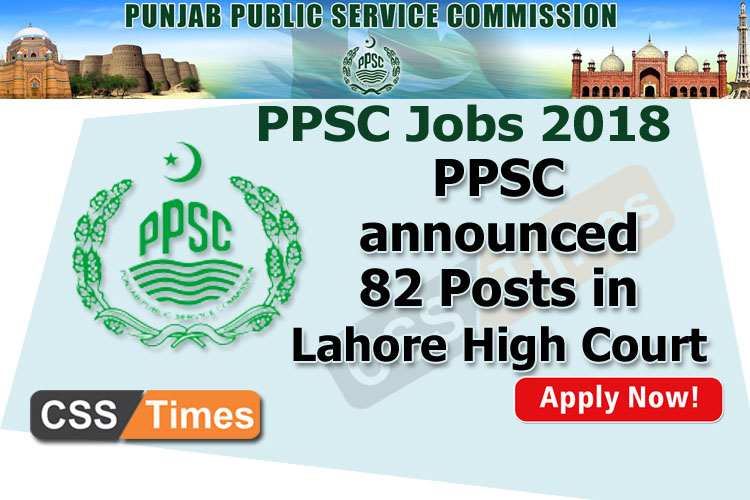
Punjab Public Service Commission (PPSC) announced New Jobs

PPSC Jobs 2018Punjab Public Service Commission (PPSC) has announced different job vacancies in The Lahore High Court, Lahore. The required qualification from a recognized institute/College/University, complete detail is given as bellow. Government job explorers must benefit this opportunity and must apply for the employment.

Suitable aspirants are encouraged to apply for the posts according to their knowledge. Unfinished and late submission will be excluded. Last date to apply for PPSC Jobs 2018: 82 Posts in The Lahore High Court application along with said documents is 27th August 2018. So don’t waste your time now and must grab the opportunity.