Categories
CSS Notes Islamic Studies

Seerah of Holy Prophet Muhammad (PBUH) As Diplomatic | CSS Islamic Studies Notes

The Holy Prophet (PBUH) is a role model for the mankind in all fields of life. He set the most perfect standards for the conduct of diplomats as well. All through his life, he was always conscious of maintaining cordial relations between Muslims and other communities. The Holy Prophet (PBUH), for the first time, came into contact with foreign world during his teenage when he went on a trade journey to Syria along with his uncle Hazrat Abu Talib. Then, during his youth he again went to Syria as a trade agent of Hazrat Khadijah (R.A). The Holy Prophet (PBUH) showed great attributes during these journeys. Hazrat Khadijah (R.A), a rich and highly influential businesswoman of that time, was so much impressed that she sent proposal for marriage to the Prophet (PBUH) that was accepted. This marriage had great impact on the life of the Prophet (PBUH) as it stabilized his financial status which enabled him to fully concentrate on propagation of Islam.

Categories
CSS Notes CSS Optional subjects

Origin of the Governance | (CSS Governance and Public Policy Notes)

Introduction

Like government, the word governance derives, ultimately, from the Greek verb (meaning to steer, the metaphorical sense first being attested in Plato). In above-described sense, however, the term governance was re-minted as recently as the 1990s by economists and political scientists, and disseminated by institutions such as the UN, IMF and World Bank. Its use in English can be traced to Charles Plummer’s ‘The Governance of England’ (published in 1885 as a translation from the original 13th century Latin of John Fortescue’s ‘The Difference between an Absolute and a Limited Monarchy’). This usage of governance to refer to the arrangements of governing became orthodox, including in Sidney Low’s seminal text of the same title in 1904 and among later British constitutional historians.

Different Uses

Governance is a very general concept that can refer to all manner of entities. Equally, this generality means that governance is often defined more narrowly to refer to a particular ‘level’ of governance associated with a type of organization (including public governance, global governance, non-profit governance, corporate governance, and project governance), a particular ‘field’ of governance associated with a type of activity or outcome (including environmental governance, internet governance, and information technology governance), or a particular ‘model’ of governance, often derived as an empirical or normative theory (including regulatory governance, participatory governance, multilevel governance, meta-governance, and collaborative governance). Governance can be used not only to describe these diverse topics but also to define normative or practical agendas for them. Normative concepts of fair governance or good governance are common among political, public sector, voluntary, and private sector organizations.

Categories
CSS Notes CSS Optional subjects

Governance Reforms in Pakistan | (CSS Governance and Public Policy Notes)

Governance Reforms in Pakistan
(CSS Governance and Public Policy Notes)

Introduction

Governance, Institutions and Development

The link between good governance and economic and social development has been well established in the last few decades. Although it is hard to have a precise definition of governance there is a wide consensus that good governance must lead to broad-based inclusive economic growth and social development. It must enable the state, the civil society and the private sector to enhance the well-being of a large segment of the population. If this definition is accepted, then economic growth in Pakistan is likely to become unsustainable if a widespread perception persists that the majority of the population has not been gaining from recent growth.  This perception, whether right or wrong, erodes political support for continuation of present economic policies and reforms.

Why does this perception persist?  The main reason is that the overall governance structure through which economics policies are intermediated and translated into economic and social benefits for the vast majority has become corroded and dysfunctional.   The governance structure of any country consists of Judiciary, Executive and Legislature.  If the access to the institutions of governance for common citizens is difficult, time consuming and costly the benefits from growth get distributed unevenly as only those who enjoy preferential access to these institutions are the gainers. How far is this true can be gauged by reference to the current state of Governance prevailing in the region but particularly applicable in Pakistan? The 1999 and 2005 reports on Human Development in South Asia aptly summarize the situation in the following two extracts:

Categories
Articles CSS Notes CSS Study Material Event

Official United States Visits by Pakistani Leaders (Complete List)

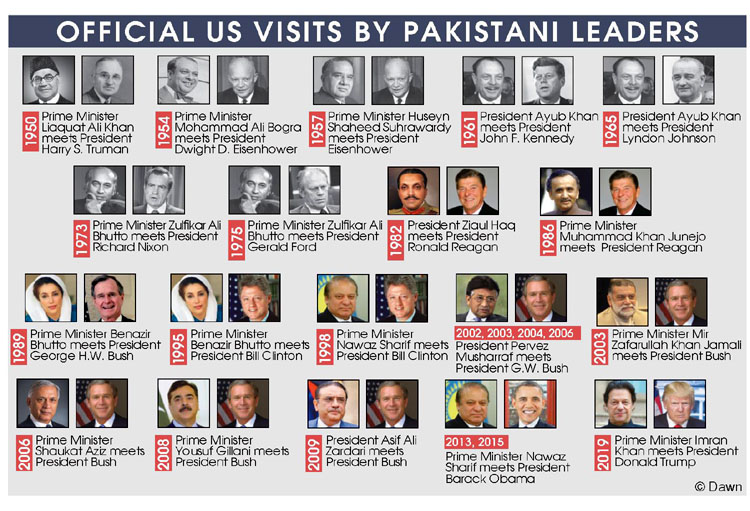
Official United States Visits by Pakistani Leaders

1950: Prime Minister Liaquat Ali Khan meets President Harry S. Truman. Official state visit paid by the first Prime Minister of Pakistan (3 May to 26 May 1950)

1954: Prime Minister Mohammad Ali Bogra meets President Dwight D. Elisenhower

1957: Prime Minister prime Minister Huseyn Shaheed Suharwardy meets President Eisenhower

President Ayub Khan’s Official visit to United States

1961: President Ayub Khan meet President john F. Kennedy

Categories
Constitutional Law CSS Notes CSS Optional subjects

Constitutional Structures (Parliamentary, Presidential, Separation of Powers) | CSS Constitutional Law Notes

The Concept of a Constitution

The whole concept of a constitution emerged from the concept of Natural Law because it was thought that nature works on certain fundamentals and therefore, there is a harmony in nature. Thus human organizations must also work on certain fundamentals and only then, there will be harmony.

In the beginning, when the man was in the state of nature, no constitution was needed. The need for a constitution arose when the men decided to live in a society or a specified territory.

Categories
CSS Notes Islamic Studies

Seerah of Holy Prophet Muhammad (PBUH) As Individual | CSS Islamic Studies

CSS Islamic Studies | Seerah of Holy Prophet Muhammad (PBUH) As Individual

Born on the 12th of the Islamic month of Rabbi-ul-awwal in Makkah, the Holy Prophet (PBUH) was born in the darkest times of Arabia. There was no concept of religion; people worshipped idols made of stones, trees, rivers, the sun and even the moon. Heinous acts such as murder, rape, adultery, gambling was of the norm back then. Female infants were buried alive and grown women were treated as objects. During a dark time like this, where all the attractions of that sinful world were tempting enough to sway any person from the path of righteousness, the Holy Prophet (PBUH) grew up with totally different beliefs about that community as compared to other people. The Holy Prophet (PBUH) lost his father before his birth and then his mother at the age of 6 and his loving grandfather as well at the age of 8. He was then brought up under the protection of his uncle.

Categories
Constitutional Law CSS Notes CSS Optional subjects

The Concept of -Rule of Law | CSS Constitutional Law Notes

Q The Concept of -Rule or Law” is an integral part of the British constitution Explain this in the light of Dicey’s Exposition on the rule of law Also elaborate us present day modem concept in a state (C.S.S.,2016)

Rule of Law

The rule of law is a term that is often used but difficult to define. A frequently heard saying is that the rule of law means the government of law, not men. But what is meant by “a government of law, not men”? Aren’t laws made by men and women in the irroles as legislators? Don’t men and women enforce the law as police officers or interpret the law as judges?

The idea of the rule of law has been around for a long time. Many societies, including our own, have developed institutions and procedures to try to make the rule of law a reality. These institutions and procedures have contributed to the definition of what makes up the rule of law and what is necessary to achieve it.

Meaning of Rule of Law

The origins of the expression “rule of law” in English are uncertain. The first recorded use of the expression that the Oxford English Dictionary can find is by John Blount. Around 1500. Blount, a kinsman of William Blount, 4th Baron Mount joy and a fellow at All Souls College, Oxford, translated into English some selected portions of Nicholas Upton’s Dc Studio Militari (a forgettable 1447 treatise on heraldry and the military). Blount rendered the Latin Juris regula as (using the spelling of his time) the Rewle of lawe.

Categories
CSS Notes General Science & Ability MCQs

General Science and Ability MCQs Solved (Exercise-1)

General Science and Ability MCQs

(Exercise-1)

The nearest star to the planet earth is:
(a) Venus
(b) Sun
(c) Moon
(d) Alpha
Answer: b

Orion is a name of a ________.
(a) Star planet
(b) Planet
(c) Galaxy
(d) Constellation
Answer: d

The largest planet of the solar system:
(a) Mars
(b) Sun
(c) Jupiter
(d) Saturn
Answer: c

Categories
CSS Notes CSS Study Material General Ability & Math MCQs

Most Important Questions for Math for Competitive Exams (PDF)

Most Important Questions for Math for Competitive Exams | Download in  PDF

Sample Questions

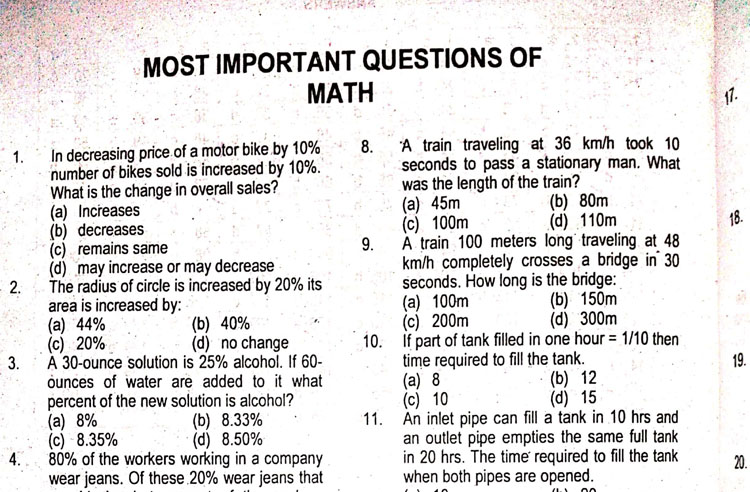
In decreasing price of a motor bike by 10% number of bikes sold in increased by 10% What is the change in overall sales?
(a) Increases
(b) decreases
(c) remains same
(d) may increase or may decrease

Categories
CSS Notes English Essay

How Tourism Situation Could Improve In Pakistan | Tourism Essay (PDF)

How Tourism Situation Could Improve In Pakistan | Tourism Essay (PDF)

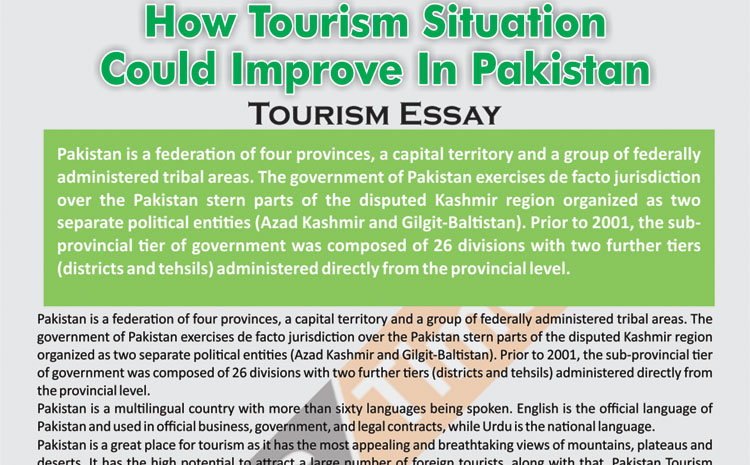
Pakistan is a federation of four provinces, a capital territory and a group of federally administered tribal areas. The government of Pakistan exercises de facto jurisdiction over the Pakistan stern parts of the disputed Kashmir region organized as two separate political entities (Azad Kashmir and Gilgit-Baltistan). Prior to 2001, the sub-provincial tier of government was composed of 26 divisions with two further tiers (districts and tehsils) administered directly from the provincial level.