Categories
CSS Notes English (Precis and Composition)

Usage of English Grammar | One word Substitution (Set I)

Usage of English Grammar | One word Substitution (Set I)

1 Chauffeur
ڈرائیور گاڑی چلانے والا ملازم
One who drives a motor-car

2 Misanthropist
A hater of mankind

3 Seismography
زلزلہ نگاری یا پیمائی
An instrument of detecting earthquake

4 Altruist
خلق دوست انسان دوست ایثار پسند
A lover of others

5 Curator
عجائب گھر کا مہتمم محافظ
A person who is in-charge of a museum

Categories
MCQs Pakistan Affairs Pakistan Affairs MCQs Pakistan Studies MCQs

Pakistan Studies/Affairs: Most Important MCQs (Set II) for CSS, PMS, PCS, NTS, FPSC

Pakistan Studies MCQs (Set II) for CSS, PMS, PCS, NTS, FPSC

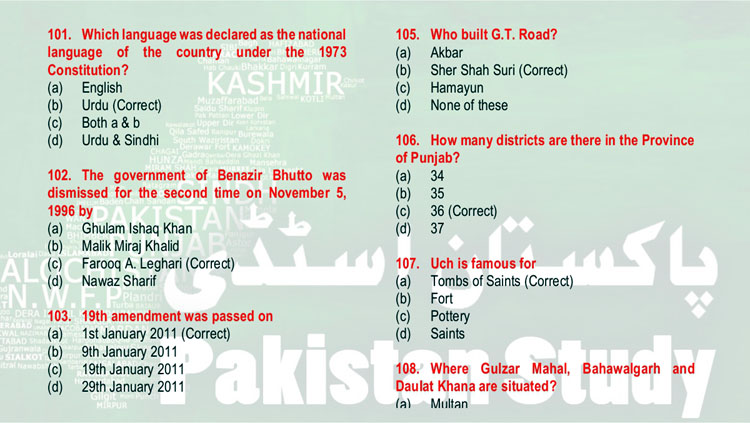
101. Which language was declared as the national language of the country under the 1973 Constitution?
(a) English
(b) Urdu (Correct)
(c) Both a & b
(d) Urdu & Sindhi

102. The government of Benazir Bhutto was dismissed for the second time on November 5, 1996 by
(a) Ghulam Ishaq Khan
(b) Malik Miraj Khalid
(c) Farooq A. Leghari (Correct)
(d) Nawaz Sharif

103. 19th amendment was passed on
(a) 1st January 2011 (Correct)
(b) 9th January 2011
(c) 19th January 2011
(d) 29th January 2011

104. Where the shrine of Khawaja Ghulam Fareed is located?
(a) Pakpattan
(b) Multan
(c) Mithankot (Correct)
(d) Bahawalpur

Read also: Everyday Science MCQs | Food Science MCQs

105. Who built G.T. Road?
(a) Akbar
(b) Sher Shah Suri (Correct)
(c) Hamayun
(d) None of these

Categories
MCQs Pakistan Affairs Pakistan Affairs MCQs Pakistan Studies MCQs

Pakistan Studies MCQs: (Set I) for CSS, PMS, PCS, NTS, FPSC

Pakistan Studies MCQs
Most Important MCQs  for CSS, PMS, PCS, NTS, FPSC

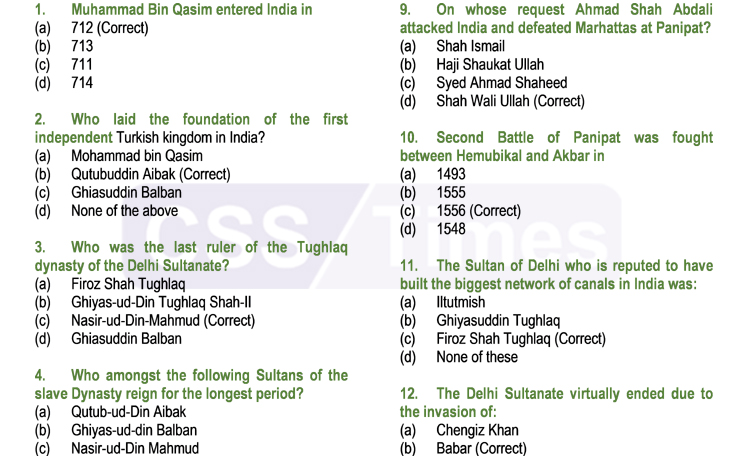
1. Muhammad Bin Qasim entered India in
(a) 712 (Correct)
(b) 713
(c) 711
(d) 714

2. Who laid the foundation of the first independent Turkish kingdom in India?
(a) Mohammad bin Qasim
(b) Qutubuddin Aibak (Correct)
(c) Ghiasuddin Balban
(d) None of the above

3. Who was the last ruler of the Tughlaq dynasty of the Delhi Sultanate?
(a) Firoz Shah Tughlaq
(b) Ghiyas-ud-Din Tughlaq Shah-II
(c) Nasir-ud-Din-Mahmud (Correct)
(d) Ghiasuddin Balban

4. Who amongst the following Sultans of the slave Dynasty reign for the longest period?
(a) Qutub-ud-Din Aibak
(b) Ghiyas-ud-din Balban
(c) Nasir-ud-Din Mahmud
(d) Shams-ud-din Iltutmish (Correct)

5. First Islamic state was established in India in
(a) 1206 (Correct)
(b) 1202
(c) 1208
(d) 1209

Categories
CSS Notes Pakistan Affairs

Political History Arrival, Foundation and Consolidation of Muslim Rule in India

Political History Arrival, Foundation and Consolidation of Muslim Rule in India

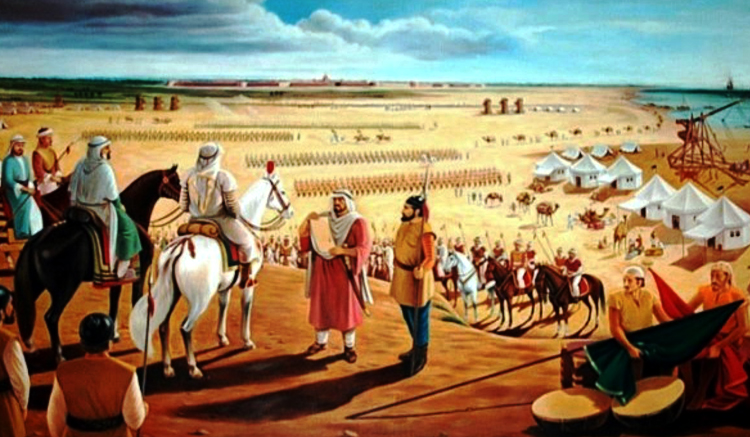
The end of Muslim rule in India was as spasmodic as its beginning. It took five hundred years for its establishment (712-1206) and one hundred and fifty years for its decline and fall (1707-1857). The benchmarks of its establishment are C.E. 712 when Muhammad bin Qasim invaded Sind, 1000 when Mahmud of Ghazni embarked upon a series of expeditions against Hindustan, 1192-1206 when Prithviraj Chauhan lost to Muhammad Ghauri and Qutbuddin Aibak set up the Turkey Sultanate at Delhi, and 1296 when Alauddin Khalji pushed into the Deccan. The stages of its downfall are 1707 when Aurangzeb died, 1739 when a trembling Mughal Emperor stood as a suppliant before the Persian Invader Nadir Shah, 1803 when Delhi was captured by the British, and 1858 when the last Mughal ruler was sent to Rangoon as a prisoner of the Raj.

For five centuries-thirteenth to seventeenth-however, most parts of India were under Muslim rule, though with varying degrees of effectiveness in different regions of the country. But at no single point of time was the whole country ruled exclusively by the Muslims. On the other hand, the five hundred year long Muslim rule did not fail to influence Indian political and cultural life in all its facets. Muslim rule apart, Muslim contact with India can be counted from the seventh century itself. Naturally, the interaction of Muslim culture with the Hindu way of life, backed by the superimposition of Muslim rule in India, gave rise to a sort of a common Indian culture. But only a sort of, there is a superficial veneer about it. On the face of it the influence of Islam on Indian culture is to be seen in all spheres of life, in architecture, painting, music, and literature; in social institutions like marriage ceremonies, in eating habits, in gourmet and cuisine, sartorial fashions and so on. In actual fact, Hindus and Muslims lead their own lives, mostly in isolation from one another, except for personal friendships. Even living together for a thousand years has not welded Hindus and Muslims into one people. Why is it so?

Categories
CSS Tips CSS Videos English Essay

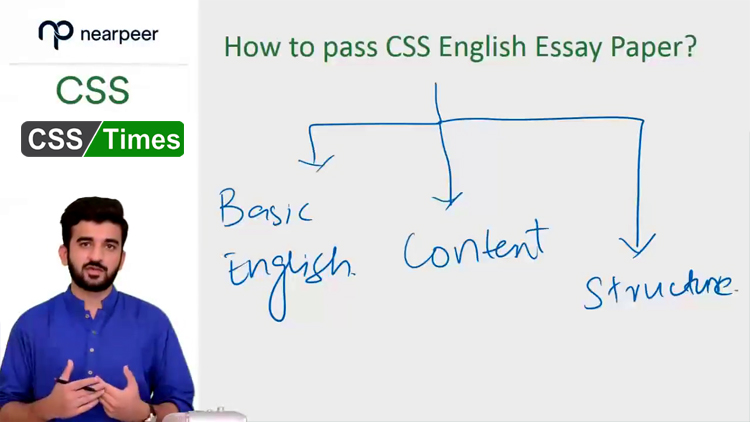
Learn the Art of Essay Writing by Hammad Ahmed (Essay Topper 2017)

Categories
Current Affairs MCQs

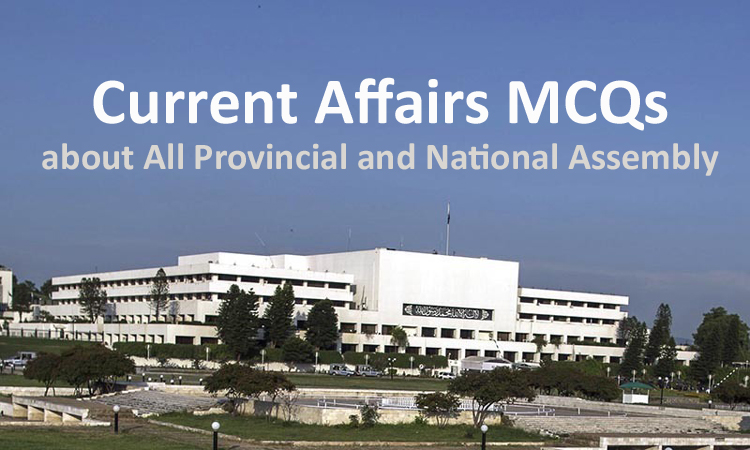
Most Important Current Affairs MCQs about All Provincial and National Assembly

Current Affairs MCQS (National Assembly of Pakistan)

Asad Qaiser sworn in as ____ Speaker of National Assembly on 15-8-2018. 21st
Who is the Current Deputy Speaker of National Assembly of Pakistan? Qasim Suri
Current National Assembly of Pakistan is_____? 15th National Assembly
Name the first female lawmaker of Pakistan, Who have been elected for a fifth consecutive time from the same general seat? Fehmida Mirza
How many reserved seats has been allotted to MMA by The Election Commission of Pakistan (ECP) for the 15th National Assembly of Pakistan? 3
How many reserved seats has been allotted to PPP by The Election Commission of Pakistan (ECP) for the 15th National Assembly of Pakistan? 11
How many reserved seats has been allotted to PMLN by The Election Commission of Pakistan (ECP) for the 15th National Assembly of Pakistan? 18
How many reserved seats has been allotted to PTI by The Election Commission of Pakistan (ECP) for the 15th National Assembly of Pakistan? 33
Which National Assembly constituency Female voters set example for all with nearly 73% turnout in 2018 elections? NA-221 Tharparker-1
Which two National Assembly (NA) constituencies results are is set to void by ECP over low turnout of female voters? NA-10 & NA-48
How many Women’s candidates made it to the National Assembly through direct General election 2018? 8
Current Election of 2018 were the ____ General Elections in Pakistan? 11th General Elections
What was the Voter turnout in General Elections 2018? 55.8% 15-8-2018.
Current Minister of Defence ? Pervez Khattak
Current Minister of Defence Production Zubaida Jalal Khan
Current Minister of Education Shafqat Mehmood
Current Minister of Energy Ghulam Sarwar Khan
Current Minister of Finance Asad Umar
Current Minister of Foreign Affairs Shah Mehmood Qureshi
Current Minister of Health Ameer Mehmood Kiani
Current Minister of Housing Ali Amin Gandapur
Current Minister of Human Rights Shireen Mazari
Current Minister of Information Fawad Chaudhry
Current Minister of Telecommunication Khalid Maqbool Siddiqui
Current Minister of Inter Provincial Coordination Fahmida Mirza
Current Minister of Law & Justice Farogh Naseem
Current Minister of Religious Affairs Noor-ul-Haq Qadri
Current Minister of States and Frontier Regions Tariq Bashir Cheema
Current Minister of Transportation Sheikh Rasheed Ahmad

Check Also: World General Knowledge MCQs | Exploring the World

Current Affairs MCQS (Provincial Assembly of Sindh)

Who is the Current Speaker of Sindh Assembly? Agha Siraj Durrani
Who is the Current Deputy Speaker of Sindh Assembly? Rehana Leghairi
Who is the Current Chief Minister of SINDH? Syed Murad Ali Shah
How many reserved seats has been allotted to GDA by The Election Commission of Pakistan (ECP) for the Provincial assembly of Sindh? 5
How many reserved seats has been allotted to MQM by The Election Commission of Pakistan (ECP) for the Provincial assembly of Sindh? 5
How many reserved seats has been allotted to PPP by The Election Commission of Pakistan (ECP) for the Provincial assembly of Sindh? 22
How many reserved seats has been allotted to PTI by The Election Commission of Pakistan (ECP) for the Provincial assembly of Sindh? 7
Who is the Current Speaker of Sindh Assembly? Agha Siraj Durrani
Who is the Current Deputy Speaker of Sindh Assembly? Rehana Leghairi
Who is the Current Chief Minister of SINDH? Syed Murad Ali Shah
Provincial assembly of Sindh? 5
How many reserved seats has been allotted to MQM by The Election Commission of Pakistan (ECP) for the Provincial assembly of Sindh? 5
How many reserved seats has been allotted to PPP by The Election Commission of Pakistan (ECP) for the Provincial assembly of Sindh? 22
How many reserved seats has been allotted to PTI by The Election Commission of Pakistan (ECP) for the Provincial assembly of Sindh? 7

Check Also: Pakistan Affairs MCQs

Current Affairs MCQS (Provincial Assembly of Khyber Pakhtunkhwa)

Who is the Current Deputy Speaker of KPK Assembly? Mehmood Jan
Who is the Current Chief Minister of KHYBER PAKHTUNKHWA? Mehmood Khan
Who is the Current Speaker of KPK Assembly? Mushtaq Ahmad Ghani
How many reserved seats has been allotted to ANP by The Election Commission of Pakistan for the Khyber Pakhtunkhwa Assembly? 2
How many reserved seats has been allotted to MMA by The Election Commission of Pakistan for the Khyber Pakhtunkhwa Assembly? 3
How many reserved seats has been allotted to PTI by The Election Commission of Pakistan for the Khyber Pakhtunkhwa Assembly? 18
Who is the Current Deputy Speaker of KPK Assembly? Mehmood Jan
Who is the Current Chief Minister of KHYBER PAKHTUNKHWA? Mehmood Khan
Who is the Current Speaker of KPK Assembly? Mushtaq Ahmad Ghani
How many reserved seats has been allotted to ANP by The Election Commission of Pakistan for the Khyber Pakhtunkhwa Assembly? 2
How many reserved seats has been allotted to PTI by The Election Commission of Pakistan for the Khyber Pakhtunkhwa Assembly? 18
Who is the Current Speaker of Balochistan Assembly? Abdul Quddus Bizenjo
Who is the Current Deputy Speaker of Balochistan Assembly? Sardar Babar Musa Khel
How many reserved seats has been allotted to MMA by The Election Commission of Pakistan for the Balochistan assembly? 3
How many reserved seats has been allotted to BNP by The Election Commission of Pakistan for the Balochistan assembly? 3
How many reserved seats has been allotted to BAP by The Election Commission of Pakistan for the Balochistan assembly? 5
How many reserved seats has been allotted to PTI by The Election Commission of Pakistan for the Balochistan assembly? 1

Current Affairs MCQS (Provincial Assembly of Balochistan)

Who is the Current Speaker of Balochistan Assembly? Abdul Quddus Bizenjo
Who is the Current Deputy Speaker of Balochistan Assembly? Sardar Babar Musa Khel
Who is the Current Chief Minister of Balochistan Jam Kamal Khan
How many reserved seats has been allotted to BNP by The Election Commission of Pakistan for the Balochistan assembly? 3
How many reserved seats has been allotted to BAP by The Election Commission of Pakistan for the Balochistan assembly? 5
How many reserved seats has been allotted to PTI by The Election Commission of Pakistan for the Balochistan assembly? 1

Current Affairs MCQS (Provincial Assembly of Khyber Punjab)

Who is the Current Deputy Speaker of PUNJAB Assembly? Dost Mazari
Who is the Current Speaker of Punjab Assembly? Ch Pervez Elahi
Who is the Current Chief Minister of PUNJAB? Sardar Usman Buzdar
How many reserved seats has been allotted to PMLQ by The Election Commission of Pakistan (ECP) for the Provincial assembly of Punjab? 2
How many reserved seats has been allotted to PMLN by The Election Commission of Pakistan (ECP) for the Provincial assembly of Punjab? 34
How many reserved seats has been allotted to PTI by The Election Commission of Pakistan (ECP) for the Provincial assembly of Punjab? 37


Categories
Articles International Relations Pakistan Affairs Pakistani Newspapers

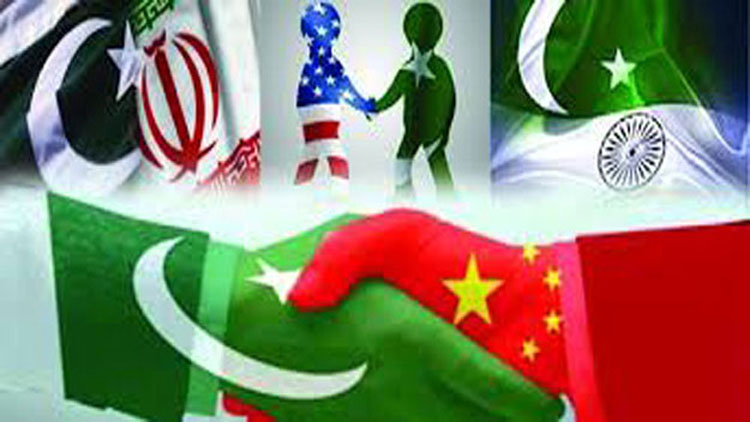
Challenges and Opportunities for Pakistan’s foreign policy (By: Iram Naseer Ahmad)

[mks_button size=”large” title=”By: Iram Naseer Ahmad” style=”squared” url=”” target=”_self” bg_color=”#000000″ txt_color=”#ff0000″ icon=”” icon_type=”” nofollow=”1″]

One of my preferred objects about International Relations (IR) is its vibrant landscape. The World around us modifies persistently which holds policies in a state of fluctuation. Therefore, the most vital responsibility of a policymaker in Pakistan’s foreign office should be to perceive, feel, comprehend and counter to the vicissitudes that are taking place across the World. The alteration itself ensues to be the most imperative part of the dilemma. Because transformation adjusts previous philosophies, it makes new supermen and villains; it retains fresh and adversative dynamisms in action and finally modification may transform intimidations into prospects and new chances into dangers. As IR have been advancing since the Treaty of Westphalia (1648), the behaviour, approaches and possibility of foreign policy have also been shifting. In the age of globalisation, more and more areas of global and regional connections today decrease within the realm of foreign policy. Expressions like cultural diplomacy, defence diplomacy, digital diplomacy and economic diplomacy are currently measured as part and parcel of foreign policy.

Furthermore, in the existing period countries belief on numerous approaches such as hard power, soft power and smart power to attain foreign policy aims. Eventually, the drive and job of a state’s foreign policy is to proficiently employ its collective asset to achieve desired ends and avert succeeding pressures and to adjust in the inter-connected world, As the British independent policy advisor Simon Anholt stated, “the central fact of the age we live in is that every country, every market, every medium of communication, every natural resource is connected”.

So, in what way is our world varying or has transformed over the past epoch? The world has improved beyond our imagination. The origin of this variation lies in technology, its stomach in policies with the mind in economics. Historically, from the wreckages of the Cold War and the socialism of Mao Tse Tung, has surfaced a China, whose economic growth has occupied the world by surprise and a model for developing states. A China directed by the thoughts of Deng Xiaoping has outstripped Japan and Germany economically, stands at number two today, and is expected to exceed the United States in the forthcoming decade or so. Against this backdrop, in any argument on foreign policy, it needs to be considered that all states — as realism proposes — are rational not emotional players. Two more points need to be distinguished. Firstly, foreign policy is the replication of a country’s internal setting and secondly, states foreign policy vestiges neither immobile nor inelastic. As the eminent American realist policymaker Robert D Kaplan proclaims, “countries neither having perpetual associates nor everlasting foes” goes by, the triumph of foreign policy, therefore, varies on sagacity and in its close conformity with the grand stratagem, security policy and domestic policy of a country. Consequently, foreign policy, exclusively piloted by a country’s national interest, is recycled as an instrument by a given nation for dealing with the outside world in innumerable parts such as security, economy, culture and technology.

In this framework, the search for international harmony continued a foundation of Pakistan’s foreign policy as marked from the concept of Quaid and in the Article 40 of the Constitution of Pakistan, whose objectives are very coherent. Like, firstly, the state shall attempt to sanctuary and reinforce amicable relationships among Muslim republics grounded on Islamic concord. Secondly, to provision the mutual benefits of the peoples of Asia, Africa and Latin America, thirdly, to promote international peace and security, fourthly, promote friendliness relations among all countries, lastly, to inspire the settlement of international disputes by peaceful means and non-aggression. In this context, Pakistan has always been an important associate of the global community when it appears to the advancement and reinforcement of global amity. Pakistan has performed an important role as a forefront state in ending the hazard of terrorism and extremism which has materialised as the most disparaging risk to international peace in the current era. But the disastrous terrorist episode of 9/11 was a serious brink in the foreign policy of Pakistan. In fact, “9/11 came as a shockwave”. As former President Pervez Musharraf himself revealed, the event brought with it unparalleled challenges for Pakistan, which insisted to “absorb external pressure.”

But on the flip side, there is good news to share, that the world around Pakistan has changed much, in fact, is still fluctuating. With more players in the game, although the environment around us is much more complex on the one side, but competitive on the other side. I do believe in modern period the foreign policy of Islamabad should be objective, Pakistani policy makers should opt a new approach to avoid the past challenges and absorb the new opportunities with fresh outlook. Now the World is demanding to contribute positively from Pakistan as a state rather than to behave like a permanent liability on Superpower’s shoulders. Consequently, it should be a gigantic job for foreign policy makers in Pakistan particularly after the recent elections held on 25 July 2018, where electorate and international community have a lot of hope from Pakistan that the slogan of “Change” should be the actual change to operate in such a challenging international milieu. No doubt, in the literature of IR, foreign policy of developing countries is the upshot of limitations and openings and it rejoins differently as linked to the great powers. By contrast, political, economic and military liabilities of feeble countries are anticipated to play a rationale role in the planning of foreign policy because they cannot afford the pressure of great power in any critical situations. In the changing settings, Pakistan should divorce its cost oriented realist foreign policy and should adopt the idealist policy with a view of avoiding confrontation with her neighbors, emerging states and the United States. Pakistan should try to make friends than enemies in this age of connectivity. Pakistan should realise that an inflexible posture will deliver a foundation for the whole structure of global compression which might affect to smash the country’s national concern. This precludes the option of mature relationship with the outside World in which Pakistan can safeguard its national values and national security respecting the core principles of our foreign policy mentioned in the article 40 of the constitution.

I conclude my words, recommending to current diplomats and foreign policy makers that they should approach to opt soft policy but without any compromise on state sovereignty, would not only significantly reduce the external pressure but also covered Pakistan’s desperate economic needs by circumventing the country to become a potential prey of international loneliness. As the pendulum of power is shifting from West to East, now is a golden opportunity for statesmen of Pakistan to get maximum advantage from new international structure but domestic settlement is the key to get foreign policy objectives in the 21st Century.

The writer is PhD in History from University of the Punjab and expertise on Pakistan-China Relations, Foreign Policy of Pakistan and International Relations.

Originally published in: Daily Nation 

Categories
Islamic Articles Islamic Studies

The majestic Qur’an | Read for CSS Islamic Studies

By: Akbar Ahmed

As a schoolboy in the hills of Abbottabad, Iread Marmaduke Pickthall’stranslation of the Holy Quran, and its stirring introduction has stayed with me to this day. Pickthall wrote:“The Qur’an cannot be translated…The book is here rendered almost literally and every effort has been made to choose befitting language. But the result is not the Glorious Qur’an, that inimitable symphony, the very sounds of which move men to tears and ecstasy. It is only an attempt to present the meaning of the Qur’an—and peradventure something of the charm in English. It can never take the place of the Qur’an in Arabic, nor is it meant to do so.”

The Meaning of the Glorious Koran was published in 1930 after authorisation from Al-Azhar University and Pickthall, a convert to Islam, had become the first Muslim Englishman to translate the Quran. It remains popular among Muslims and non-Muslims alike.

Categories
Articles Current Affairs Pakistani Newspapers

The 22nd Prime Minister | CSS Pakistan Affairs

[mks_button size=”medium” title=”Muhammad Zahid Raffat ” style=”squared” url=”” target=”_self” bg_color=”#59d600″ txt_color=”#FFFFFF” icon=”” icon_type=”” nofollow=”0″]

Month of August in the calendar year is already important because in this month we celebrate our independence every year on August 14.

But at least for the present, this month has gained more importance as within few days from now the country is going to have a new Prime Minister on the basis of mandate given by the people in the general election to the 15th  National Assembly  in the very fair, transparent, peaceful and orderly manner held on July 25, 2018.

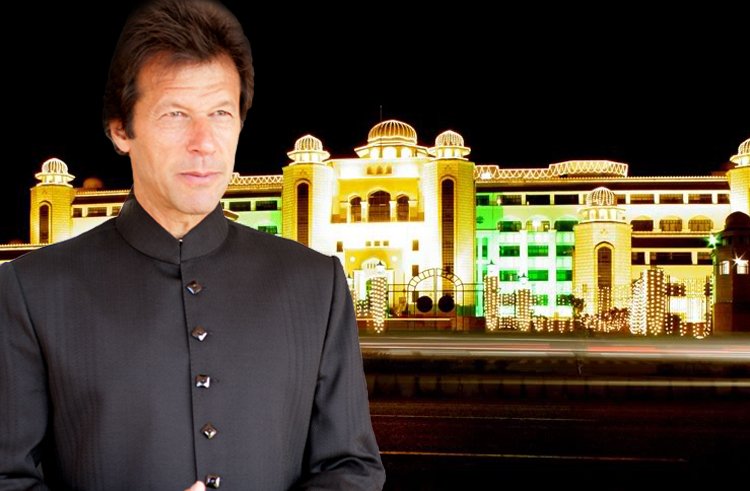
The new Prime Minister in the Prime Minister’s House in Islamabad is going  to be none else but Chairman of Pakistan Tehreek-i-Insaaf (PTI) Imran Khan. As a matter of fact, both Imran Khan and his party PTI are new in the corridors of powers at the national level. PTI was the ruling party during last five years in the province of Khyber Pukhtunkhwa on the basis of mandate of the people it had secured in 2013 general election.

PTI and allies have adequate number of seats in the National Assembly to form the new government after Imran Khan is voted as the new Prime Minister in the new National Assembly inaugural session in couple of days. United Opposition parties including former ruling parties PML(N) and PPP and religious parties revived alliance Mutahidda Majlis-i-Amal (MMA) and other parties have put up PML(N) President and formerly Punjab Chief Minister Shehbaz Sharif as their joint candidate for the top slot of the Prime Minister mainly to ensure that the PTI Chairman is not elected as the new Prime Minister just unopposed.

PTI is the newest ruling party at the national level in about 71 years politically chequered history of Pakistan. Previous  ruling parties for varying periods were Pakistan’s founding party Muslim League, Awami League,Republican Party, Pakistan Peoples Party, Pakistan Muslim League , Pakistan Muslim League (Nawaz), Pakistan Muslim League (Quaid-i-Azam).

These ruling parties are besides the bitter fact that the country has been ruled for longer and shorter period by four military dictators in Field Marshal Muhammad Ayub Khan , General Agha Muhammad Yahya Khan, General Muhammad Ziaul Haq and General Pervez Musharraf. Till now, the country had seven caretaker Prime Ministers also in Ghulam Mustafa Jatoi, Mir Balakh Sher Mazari, Moeenuddin Ahmad Qureshi, Malik Meraj Khalid, Muhammedmian Soomro,  Mir Hazar Khan Khoso and Justice ® Nasirul Mulk for running day to day affairs and supervising holding of  general election or mid-term or full term basis.

It is pertinent to mention here, mainly for record purposes, that during the electoral campaigns to July 25, 2017 general election, PML(N) President Shehbaz Sharif, PPP Chairman Bilawal Zardari and PTI Chairman Imran Khasn had made it quite ominous that in case their parties emerge victorious in the polls, then either of them will be the new Prime Minister of the country. And, the people have voted in favour of PTI Chairman to occupy the office of the Prime Minister for next constitutional tenure of five years.

Historically and statistically speaking for keeping the records state, Pakistan is about to turn 71 in few days from now on August 14, 2018 with the continued blessings of Almighty Allah despite all the internal and external challenges and problems it had and still facing all these years. Being 71 is obviously quite small period in the life of the nation which had come out in existence out of nowhere on August 14, 1947 under the inspiring leadership and principled statesmanship of  Quaid-i-Azam Muhammad Ali Jinnah  and is destined to remain on the world map as long as blessed by Almighty Allah.

But most unfortunately and due to persisting political instability and fragile democracy every now and then, Imran Khan will be assuming the high office as the 22nd Prime Minister of the country despite the bitter that the post had remained abolished during the varying periods of four military dictators, as mentioned above,  and seven caretaker Prime Ministers.

The post of the Prime Minister was created  at the time of creation of Pakistan. Since the post of the Governor General had not been abolished in the beginning, the Prime Minister in office initially  did not have all the executive powers . Following the 18th Constitutional Amendment passed only in 2010, the Prime Minister is the executive head of the State of Pakistan and as such the incumbent in the office enjoys more powers than any other government officials including the President.

After the first political murder and unfortunately assassination of Pakistan’s first Prime Minister Liaquat Ali Khan  on October 16, 1951 while he was addressing a public meeting in Gol Bagh, Rawalpindi, there were as many as seven different  prime ministers  within the short span of six years. All of them were from Pakistan founding party Muslim League except  Malik Feroze Khan Noon who was the first one from the newly-formed Republican Party and also Huseyn Shaheed Surhawardy who hailed from Awami League.

It is also a bitter fact that none of the 21 Prime Ministers somehow had not completed their tenure  due to varying reasons and factors. PPP”s Syed Yousuf Raza Gilani  held the post  for four years two months and 25 days prior to his being unseated and convicted by the Supreme Court of Pakistan. Previously, Liaquat Ali Khan had served the longest period of four years two months and 2 days as the first Prime Minister.

PML(N) own faction chief Nawaz Sharif had become the Prime Minister three times but still ion aggregation his three tenures, all remaining incomplete somehow,  totalled up to 5 years, two months and 27 DAYS.  After aggregating  Benazir Bhutto’s two terms, her total period in power  comes to four years 8 months and 21 days. Both Benazir Bhutto and Nawaz Sharif somehow could not complete even a single five years constitutional tenure though they duly elected Prime Ministers twice and thrice respectively.However, both Nawaz Sharif and Benazir Bhutto  are the longest serving prime ministers though non-consecutively.

The governments of Prime Ministers Benazir Bhutto and Nawaz Sharif  were dismissed twice and once respectively  by Presidents Ghulam Ishaq Khan and Sardar Farooq Ahmad Khan Leghari. However, Nawaz Sharif on being removed in April 1993 was reinstated in May and then he had resigned the office in July 1993 along with President Ghulam Ishaq Khan after both of them had reached point of no return and following an agreement brokered by the high quarters concerned to save the situation. Nawaz Sharif’s second term was curtailed in October 1999 when Chairman Joint Chiefs of Staff Committee/Chief of Army Staff General Pervez Musharraf seized power through a coup.. Nawaz Sharif’s third term  as an off shoot of the 18th Constitutional Amendment  was cut down in July 27, 2017 when he was disqualified by the Supreme Court of Pakistan in Panama Papers Leaks case.

 Then after the first coup d’etat of the newly born country staged by General Muhammad Khan in October 1958, the post of the prime minister had remained  abolished for a pretty  long period of 13 years and 2 months including short tenure of second military ruler General Agha Muhammad Yahya Khan till 1971.

There was a short period of recreation of the post when Nurul Amin was appointed as the Prime Minister merely for 13 days in December 1971. Alongside him, General Yahya Khan  had also illegally made PPP’s Zulfikar Ali Bhutto and Awami League’s Sh Mujibur Rahman as the Vice-Prime Ministers  though they had not acquired these positions.

Former ruling parties have been mentioned already briefly, regular Prime Ministers names  in short are Liaqat Ali Khan, Khwaja Nazimuddin, Muhammad Ali Bogra, Ch Muhammad Ali, Huseyn Shaheed Suhrawardy, Ibrahim Ismail Chundrigar, Malik Feroze Khan Noon, Nurul Amin, Zulfikar Ali Bhutto,Muhammad Ali Junejo, Benazir Bhutto,  Nawaz Sharif, Mir Zafarullah Khan Jamali, Chaudhry Shujaat Hussain, Shaukat Aziz, Syed Yousuf Raza Gilani, Rana Pervaiz Ashraf and Shahid Khaqan Abbasi.

Ironically, Pakistan Muslim League (Quaid-i-Azam), Pakistan Peoples Party and Pakistan Muslim League (Nawaz )  had completed  their constitutionally tenure  of five years each between 2002 to 2018 one after the other. However, due to varying reasons, PML (QA) had three, PPP two and PML(N) also two Prime Ministers during their respective constitutional tenures.

Total duration of democratically elected Prime Minister  aggregates to 34 years 11 months and 14 days, the four military dictators ruled the country as Chief Martial Law Administrator/President almost for the same period.

Lot more in this regard after country’s 22nd Prime Minister is inducted in the office  and the Nation celebrates another Independence Day within next few days, please.


The writer is Lahore-based Freelance Journalist, Columnist and retired Deputy              Controller (News) Radio Pakistan, Islamabad.

zahidriffat@gmail.com

Originally published in Daily The Nation (August 11, 2018)
Categories
Current Affairs Pakistani Newspapers

IS IMF AVOIDABLE? (By Shahid Kardar)

[mks_button size=”large” title=”By Shahid Kardar” style=”squared” url=”” target=”_self” bg_color=”#dd3333″ txt_color=”#FFFFFF” icon=”” icon_type=”” nofollow=”0″]
IT is now generally recognised that we face the herculean task of settling our external obligations. However, what is less widely understood is that the structural factors underlying the massive current account deficit of and the rapidly growing debt repayments have made the present crisis deeper and more protracted in nature (especially with the rising price of oil). In the short-term the external financing gap presents a formidable challenge with the more immediate requirement likely to be $28 billion for the current year.
And the fiscally irresponsible budget for 2018-19 tabled by the outgoing government is expected to worsen both the external and domestic imbalances, thereby queering the pitch for the next government, making its task even more daunting, both economically and politically (the latter may just make the withdrawal of the income tax concessions almost impossible).