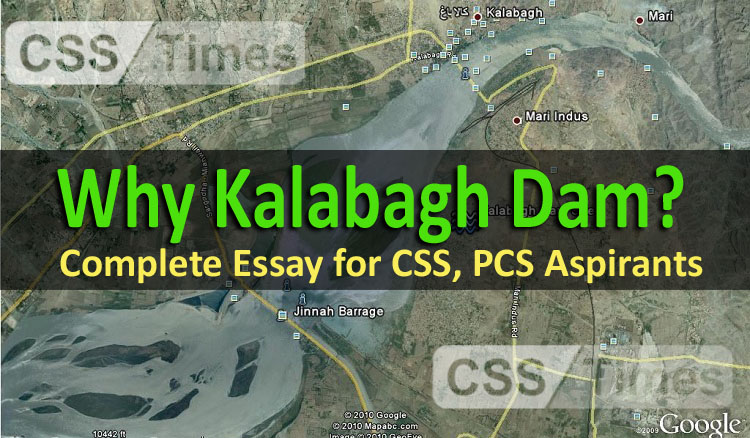
Why Kalabagh Dam? Essay Outline
Introduction
- Controversial national issues should be discussed media and pun to develop a public opinion.
- It is important to arrive at a common can giving due weightage to each federating units view
Pros and Cons of Kalabagh Dam
Social costs
- Some parts of thickly populated areas of NWFP submerged in Kalabagh Dam.
Pros
1. Pakistan needs to consume water resources to the agricultural production.
2. To prevent wastage of 40-42 m acre ft., walk of river in the sea away year.
3. To prevent severe conditions of famine in a century by building more water reserves and the agricultural output.
4. Kalabagh dam will have water free of sediment an enhanced age and capacity.
Cons and their remedies:
1. This dam would adversely affect some areas of NW. It could be minimized by making some tech changes in project, though it will affect the store electricity generation capacity of dam.
2. Natural plantation along Indus River would be as this can be checked by regulating amount of in river.
3. Royalty issue.
Conclusion:
Why Kalabagh Dam? Complete Essay
The Nation has done a service to its readers by publishing two articles at a time, one for and the other against on the Kalabagh Dam (April 18, ’97). It is a good way of evolving general consensus on current controversial national issues. Thorny issues need to be laid threadbare objectively for building public opinion through the national press and other mass media.
I believe it is high time that the Kalabagh Dam issue is debated on the PTV in its pros and cons in which the concerned provinces having certain reservations should be involved to present a balanced view to the viewers. A society wedded to democracy is supposed to crystallize public opinion to resolve knotty, complex issues which in routine admit to no easy solution. It is necessary to give due weightage to the viewpoint of each province to arrive at a common consensus. No arbitrary decision can be taken in matters that become controversial in a federation. If the federating units have certain reservations about a project which they think could militate against the interests of a few and benefit others, the fears and doubts must be removed to reflect a common consensus. Unfortunately, we have not been able to create conducive environs for the promotion of integration culture. The reasons are mostly found to lie in immature democratic traditions and institutions. If democracy had grown firm roots in the home soil there would have been a greater spirit of give and take on the part of the federating units to arrive at a consensus meant to promote national welfare. True, the national welfare is linked to the welfare of each federating unit though in the process welfare of one may be greater than the other. National welfare is to be perceived as an indivisible unit, which is to be promoted in the larger setting.
It is with reference to Mr. Aziz-ud-Din Ahmad’s article, ‘The Other View’ published in The Nation (April 18, ’97) that I wish to comment on some of the points raised therein. The writer expresses certain fears of the NWFP people that the construction of Kalabagh Dam is likely to submerge parts of the thickly-populated areas like Akora Khattak etc. But the position of Punjab also does not emerge out to be a pleasant one on this score. The Punjab would have to surrender double the area than that of the NWFP to be submerged in the dam in the event of the materialization of the project. Both the provinces have to make sacrifice in the form of surrendering a certain percentage of the area at the altar of the dam.
The construction of a dam leads to displacements of the existing towns and villages as it happened in case of the old Mirpur city (AJK) plus a host of other villages. The old town along with peripheral human habitations was merged in the Mangla Dam. One may regard it as unavoidable of the process of dam construction. That holds well in case of every dam. If Bhasha Dam was constructed, Karakuram Highway leading to China would be submerged in water and it will have to be rerouted. Obviously, it involves a price which has to be paid for constructing Bhasha Dam.
What to talk of mosques, graveyards, even the houses in which people have been living since centuries have to be surrendered to a dam which eventually would be submerged in the water of the dam. It is a price which is to be paid by the people of certain areas by parting with their dwellings, land, etc. The inconvenience and discomfort suffered by the people in the form of leaving their age-old habitations and settling at new places are the social costs of the dam which are to be borne willy-nilly. People in our society are sentimentally attached to their ancestors, and are likely to be upset if the graveyards are to be rolled over and submerged in the water of the dam. Graveyards are towers of silence where nothing but silence prevails — the dead are dead. The best way to pay homage to the departed souls is to continuously dispatch blessings through prayers and also to do good deeds in this world by earning honest living, observing canons of social justice, avoiding tyranny as per Islamic tenets. True, the people are sentimentally attached to their ancestors. They love their bones. As an alternative, the bones of the dead could be carried over to a new cemetery in new human habitats to be known after the original name of the place. That can be done to pacify the sentiments of the people sticking emotionally to old conventions, beliefs and customs.
Water is available in our rivers in mid of June through end of September but it is not available in the required quantities to meet the Rabi crop requirements. During this period, inter-river management technique is used to provide water to the cultivable land. It is estimated that 140 million acre feet water is available in Pakistan out of which 95 million acre feet are utilized during the Kharif season. The problem in Pakistan is to conserve water resources to increase agricultural production for feeding the growing population. The end could be achieved if water resources are stored through dams to be utilized for bringing more area under cultivation in Thal, Cholistan and Thar deserts to increase agricultural production not only to feed the growing population but also to increase exportable surpluses to earn foreign exchange. It is an irony that Pakistan spends a lot of foreign exchange on the import of wheat, which it should produce in abundance at home. The solution thus lies in bringing new area under cultivation in the aforesaid belts through the provision of additional water resources. The issue of boosting agricultural production is of vital importance for our survival as a nation, which calls for conserving water through the construction of a number of dams in time to come. We need not only one dam but many more dams.
On an average, Pakistan wastes 40-42 million acre feet water of the Indus River in the sea every year. It is learnt on good authority that last year 90 million acre feet water remained un-utilized as it flowed to the sea. It is the highest quantity of water wastage in a country where a single million acre feet water is to be valued, conserved and utilized. The present capacity of the Tarbela Dam is 10 million acre feet water. In other words, we allowed nine Tarbela dams to be sunk into the sea by wasting 90 million acre feet water last year. That is a classic example of extravagance and waste of scarce water resources which ought to have been utilized for increasing agricultural production through the construction of a dam. If we do not settle the issue and allow it to procrastinate, we would be increasing the woes of the poor.
As far as I know, a World Bank report anticipates the year 2005 to be a very crucial year for Pakistan when it will be faced with severe conditions of famine. If we don’t act in time, we will be face to face with a famine-like situation in the coming century by the year 2005, which is not far-off. Let all the provinces recognize the fatal hour when the country would be in the throes of a famine. Would then we be bothering about the loss of existing graveyards or creating new graveyards? One shudders at the idea of famine befalling Pakistan if new areas are not brought under cultivation consequent upon the provision of additional water facilities. Construction of Kalabagh Dam could go a long way in providing additional water facilities for the purpose of increasing acreage to yield additional increase in agricultural output.
It is claimed that the life of Kalabagh Dam is linked to that of Tarbela Dam. At present, the sediment is being accumulated in the lake of Tarbela Dam and relatively, water free of sediment would reach Kalabagh Dam. That is likely to enhance its age and capacity. By not building Kalabagh Dam, we are reducing its age. Hence any act of procrastination is going to adversely affect the age and capacity of the Kalabagh Dam.
The adverse effects of Kalabagh Dam, particularly on the would-be affected areas in the NWFP, could be minimized if the height of the dam is reduced by fifteen feet. That is technically feasible and it could be done with the concurrence of the concerned provinces. Water-logging and salinity effects could greatly be avoided if an alternative proper drainage system is included in the dam project. The Punjab would, however, be exposed to the evil effects of the twin evils: The height of the dam could be reduced to achieve the objective though that might affect badly the storage capacity of the dam. It might also tell upon the hydel generating electric capacity of the dam.
The objection of the Sindh province is that Kalabagh Dam would adversely affect the natural plantation and land if zero amount of water is thrown into the sea. In that event, sea salt water intrusion would damage the natural plantation. The objection of Sindh could be taken care of by throwing required supplies of water in the Indus for keeping the natural plantation intact. It is not difficult to meet the demand of the Sindh province.
Kalabagh Dam would help control flood by storing the water to be utilized for the purpose of irrigation and also generating electricity. It would be a source of hydel power, which is overwhelmingly cheap as compared to thermal power. It could provide electricity to accelerate the rate of industrialization in the country which holds a key to the reduction in economic poverty. Kalabagh Dam is a multi-purpose dam, whose early completion is in the national interests.
In the end, we may mention the royalty aspect which, some say, has been an impediment to the start of Kalabagh Dam. The royalty could be shared by the provinces through an amendment in the Constitution. If the Parliament so decides about the sharing of royalty in certain proportion among the concerned provinces, the issue can be resolved. It should no longer constitute an obstacle to the materialization of the project. Let there be Bhasha Dam also and many more dams. We need dams. The name Kalabagh may be changed to Greenbagh, if controversy pertaining to name is thought to be an impediment in the way of the project.
Book Source:
Paragraph and Essays by Prof Manzoor Mirza
(Published by: Ilmi Kitab Khana)