Categories
English Essay

Provincial Autonomy | CSS Essay Material

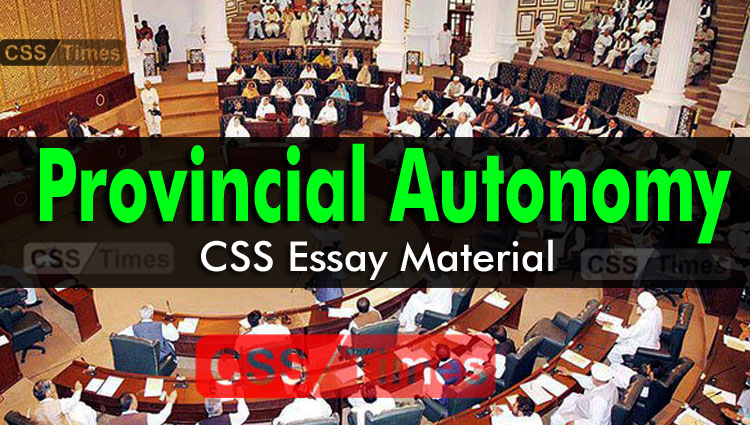
Pakistan is in an imminent danger to breaking up or that such an eventuating is inevitable. It is true that some of elites in its smaller provinces are dissatisfied with their share of the things the country generates. But their grievances are not huge and the demands accompanying them are not all that difficult to meet.

The basic grievance is that the Punjab is dominating the central government, further they dominate commerce in the smaller provinces, and they have taken too many posts in their government and administration. These assassins may be slightly exaggerated, but they are not entirely unfounded.

There, the inescapable tact is that Punjab constitutes more than 60 per cent of the counter’s population. The sheer logic of numbers makes them dominant in matters that fall domains.

Categories
Articles Current Affairs Pakistani Newspapers

The Rise of Political Entrepreneurship in Pakistan | (Pakistan’s Domestic Affairs)

By Jamal Sohail

“Democracy is in the blood of the Muslims, who look upon complete equality of mankind, and believe in fraternity, equality, and liberty.”
– Quaid-e-Azam Muhammad Ali Jinnah, founder and 1st Governor-General of Pakistan

On 18 August 2018 Imran Khan was sworn in as the 22nd Prime Minister of Pakistan with his political party, the Pakistan Tehreek-e-Insaf, having won the general elections. It was an important victory as it disrupted the existing multi-party politics of Pakistan which was dominated by two main parties, the Pakistan People’s Party (PPP) and the Pakistan Muslim League Nawaz (PML-N), for the last 40 years and more, making Imran Khan a political entrepreneur. Entrepreneurship is defined as the readiness to take the risk of taking on a business venture that will create a new market, disrupting the existing market in order to make profit and of succeeding. In entrepreneurship the person who starts the company is called an entrepreneur and the company in its initial stages is called a start-up and undergoes three main phases, the start-up phase, the growth phase, and the exit phase. In politics Imran Khan’s PTI broke the status quo and went through all these phases since being founded in 1996.

Categories
Articles Current Affairs Pakistani Newspapers

Institutions and Policymaking | (Pakistan’s Domestic Affairs) | CSS Current Affairs

By: Iftikhar Ahmad

A general sense of dissatisfaction about credibility of accountability and performance of government is nothing new. Students of public administration and public policy and experts from allied fields of study such as sociology, political science and economics have been engaged in structural functional analysis with a view to improving the system of government that impacts the life of citizens. Microeconomic goals suggest as to how to improve the functioning of the state itself by emphasizing anti-corruption measures. The problem in this context is that international institutions such as IMF and world Bank may get an incorrect perspective that fails to recognize the role of political institutions and the constraints they place on policymaking. Adopting better policies and institutions are not successful because they do not take place in the context of an explanation of why bad policies and institutions are there in the first place. Also, there are problems of non-implementation which render all efforts at policymaking futile. It suggests the need to define the relationship of administrative functions to the Legislative, executive, and judicial branches of government, and also to have an idea of comparative perspective of administration and administrative organizations.

For illustrative purposes, it is helpful to liken the flow of authority in governmental administration to that in private corporations. In such an analogy, the legislature roughly corresponds to a “board of directors” which determines over-all activities and policies. The executive roughly corresponds to a “general manager” who, with the approval of the directors, supplies immediate leadership, directs activities, and assumes responsibility for making important staff appointments. Members of governmental administration correspond to the rank and file of department heads and subordinates who perform specified tasks as responsibly as possible within their limited spheres and give impartial treatment to the public. At all times, administrators are liable to censure by the legislature, to discipline by the executive, to over rulings by the courts, and to criticisms from the public-which range from general charges of “bureaucracy” to complaints about inefficiency in the performance of particular tasks. Administrators may sometimes initiate policies that are adopted by their superiors, but they usually conduct their work efficiently without expecting more than a small measure of recognition; sometimes no recognition at all has been forthcoming.
Categories
Current Affairs Pakistani Newspapers

What ails Pakistan | (Pakistan’s Domestic Affairs) | CSS Current Affairs

By: Yasser Latif Hamdani

While the powers that be and politicians fight for the control of the state, there are festering wounds in our body politic that remain unaddressed. Real issues are persistently ignored and swept under the carpet with devastating results.

On October 25, 2019 yet another Ahmadi “place of worship” was desecrated by the state in Bahawalpur. Countless individuals remain behind bars on blasphemy charges including the young professor Junaid Hafeez. Countless young women from minority communities will continue to converted forcibly to Islam in Sindh. The Federal Capital will see yet another Dharna where inevitably religion will be misused. Fundamental rights such as freedom of religion and freedom of expression will continue be trampled for political expediency and freedom of press will continue to be denied. Meanwhile the economy continues to nosedive. By February 2020, we may even be on the FATF blacklist. Our brightest minds continue to flee the country. Such is the state of affairs in Pakistan in the closing months of 2019.

Categories
English Essay

Brain Drain; Causes and Implications (CSS Essay)

            The term “brain drain” designates the international transfer of resources in the form of human capital i.e., the migration of relatively highly educated individuals from the developing to developed countries.

            This phenomenon, in the terminology of development economics refers to the loss of high quality manpower, which was once productively employed in the native country. The last decade has seen an increase in the international mobility of highly skilled, talented individuals in response to the expansion of the knowledge economy accompanying globalization. This international movement of human capital can be identified, in practice, as the movement of scientists, doctors, educationists, engineers, executives, and other professionals across frontiers. These are people with special talents, high skills and specialized knowledge. The irony of international migration today is that many people who migrate legally from poor to richer lands are the ones that the Third World Countries can least afford to lose: the highly educated and skilled. Since the great majority of these migrants move on a permanent basis, this perverse brain drain not only represents loss of valuable human resources but could prove to be a serious constraint on the future economic progress of Third World nations. Expenditure on education in Pakistan and other developed and developing countries: Research undertaken both in developed and developing countries reveals that for an increase in output, the quality of labour is more important than the quantity. A clear picture emerged if one looks at the experience of different countries. No country with educated and technically trained human resource is poor and no country with a predominantly illiterate, untrained human resource is rich.

Categories
Articles Current Affairs Pakistani Newspapers

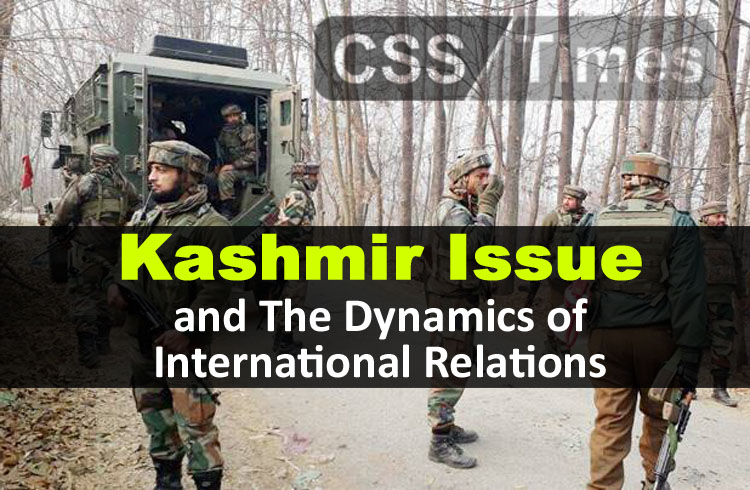
Kashmir Issue and The Dynamics of International Relations (Sheraz Zaka)

Imran Khan has urged Pakistanis to come out of their homes, offices and workplaces every week for half an hour to show solidarity with the Kashmiri people fighting Indian occupation. One expected him to tell the nation about his government’s latest initiatives on the diplomatic and political fronts to mobilise international support for the Kashmiri struggle for the right of self-determination. More importantly, what are the options for Pakistan to deal with the worsening crisis? We cannot move the international community into action by raising the spectre of a possible nuclear conflagration.

Undoubtedly there has been unprecedented coverage in the western media of Indian brutalities and human rights violations that exposes Modi’s claim of normality returning to the occupied territory. But that is not sufficient to compel other countries to stand with the Kashmiri people. The international community’s silence over the lockdown of more than eight million people and the suppression of their fundamental democratic rights may be driven by geopolitical and economic considerations, but it also reflects our diplomatic failure.

Categories
English Essay

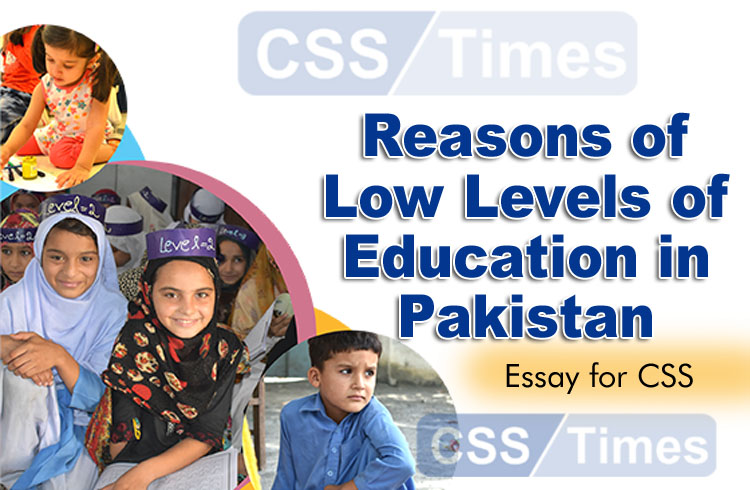
Reasons of Low Levels of Education in Pakistan (Essay for CSS)

Our educational system has not undergone any change with the change brought about by political independence. It bears no imprint of freedom and appears to be as listless as it used to be during the days of slavery. Our universities still remain glued to that old colonial era pattern. The imperfections of that pattern are now keenly felt and there is a great need to introduce a radical change in the educational system.

Low literacy rate and poor quality of education are the major drawbacks of the educational system in Pakistan. Our education system is influenced by a number of factors. Some of them are more prominent, such as low enrolment and high dropout rate at the primary level, different standards of education, low budget allocation for education sector, political interference, low quality of curricula and textbooks, rapid growth in population, poverty and unemployment, poor quality of teachers and irrelevant induction of duties, and our substandard evaluation system. Although the government claims for some bold steps to overcome these problems, there is still room for improvement.

Categories
English Essay

Education and Extremism in Pakistan (Essay for CSS)

Extremism in the name of Islam has greatly affected the structural stability and functionality of Pakistani society and the state in recent years. Extremism could be effectively prevented and countered through viable educational infrastructure in the country. The case of Pakistan in this context is unique. In our country, educational institutions and academia have become a key factor in extremism and terrorism. Although regarding the connection between education and extremism in Pakistan much attention has remained focused on the role of madrassas, the main issue is the failure of successive governments and regimes to provide adequate education infrastructure and curricula.

On the contrary, social scientists and educationists are concerned about the curriculum taught in public schools and think it is fixated on religion and ideology and that it needs to be reformed. Many studies on the syllabi in Pakistan corroborate their view.

Categories
Essays Outlines

New War Fronts Lie in Economic Zones (Essay Outline by Awais Aftab Butt)

1-Introduction

2- An overview of different zones of warfare

3- Facts which prove that new war fronts lie in economic zones

  • The ghost of US-China Trade war
  • Crippling economic sanctions on Iran
  • Trade Embargoes on rogue regimes e.g. North Korea
  • Suspension of Trade with hostile countries e.g., Indo-Pak trade suspension
  • Use of Financial Action Task Force (FATF) listings for non-compliant jurisdictions
  • Hurling of Threats to labour exporting countries of repatriation of workers
  • Imposition of Tariffs and Quotas
  • Political manoeuvering of IMF and World Bank
  • Designation of companies and High Net Worth individuals of rival countries (US sanctioning Russian companies, US blacklisting Huawei)
  • Restrictions on International Banking Channels
Categories
English Essay

Democracy Has Failed to Deliver in Pakistan! (Essay for CSS)

Democracy Has Failed to Deliver in Pakistan!

“Why democratic System is Weak in Pakistan: Causes and Solutions”

Pakistan has been in quest for stable democratic system from its very inception. The process of its democratization has been slow and passive. Its nature has remained fragile. It has been showing high vulnerability towards non democratic interventions. Besides, it has been easily falling prey to non-civilian forces. As a result, Pakistan has been continuously failing to offer what a democracy promises. Such pathetic scenario has various reasons behind it at all three levels: State, government and society.

This Essay attempts to pin point and analyze the reasons behind such fragile and weak nature of democracy in Pakistan and extends recommendations along with identifying various means and players especially youth for strengthening democratic process in Pakistan to make it promising and delivering.