Categories
GK MCQ’s Islamic Studies Islamic Studies MCQs MCQs

ISLAMIAT Important & Selected Solved MCQs For Competitive Exams (Set-II)

ISLAMIAT Important & Selected Solved MCQs
For Competitive Exams (Set-II)

51. Holy Prophet (PBUH) delivered his farewell sermon at Arafat on:
(a) 8th Zulhajj
(b) 10th Zulhajj
(c) 9th Zulhajj
(d) 11th Zulhajj
Answer: B

52. The Treaty of Hudabia was signed in:
(a) 5th Hijrah
(b) 6th Hijrah
(c) 7th Hijrah
(d) 8th Hijrah
Answer: B

53. Makkah was conquered in:
(a) 8th Hijrah
(b) 9th Hijrah
(c) 10th Hijrah
(d) 12th Hijrah
Answer: A

54. Abdullah bin Ubay was a:
(a) Hypocrite
(b) Christian
(c) Jew
(d) Great leader
Answer: A

55. The largest army that ever marched out of Medina was consisted of:
(a) 10,000 men
(b) 30,000 men
(c) 40,000 men
(d) 45,000 men
Answer: B

56. The largest army that ever marched out of Medina was in:
(a) Ghazwa Uhad
(b) Ghazwa Tabuk
(c) Ghazwa Saweeq
(d) Ghazwa Ahzab
Answer: B

57. Jizya means:
(a) Religious tax
(b) Poll-tax on non-Muslims
(c) Lands cultivated by non-Muslims
(d) Income from the minorities
Answer: B
Categories
GK MCQ’s Islamic Studies Islamic Studies MCQs MCQs

Important ISLAMIAT MCQs For Competitive Exams (Set-I)

Important ISLAMIAT MCQs For Competitive Exams (Set-I)

Important ISLAMIAT MCQs 1 – 10

1. The first Surah in the Holy Quran is:
(a) Surah Al-Fatihah
(b) Surah Al-Baqarah
(c) Surah Al-Imran
(d) Surah Al-Ikhlas
Answer: A

2. The last Surah in the Holy Quran is:
(a) Surah Ya Sin
(b) Surah Al-Nas
(c) Surah Al-Falaq
(d) Surah Al-Kauthar
Answer: B

3. The longest Surah in the Holy Quran is:
(a) Surah Al Imran
(b) Surah Al-Baqarah
(c) Surah Al-Falaq
(d) Surah An-Nisa
Answer: B

4. The shortest Surah in the Holy Quran is:
(a) Surah An-Nisa
(b) Surah Al-Ahzab
(c) Surah Al-Baqarah
(d) Surah Al-Kauthar
Answer: D

5. The number of Prophets whose names are in the Holy Quran is:
(a) 10
(b) 25
(c) 35
(d) 45
Answer: B

6. The total number of Makki Surahs are:
(a) 80
(b) 86
(c) 88
(d) 92
Answer: B

Categories
English Essay Essays Outlines

CSS Essay on Baluchistan Problem and Solutions

CSS Essay Outline on Baluchistan Problem and Solutions

The protracted and simmering issue of Baluchistan morphed into full-blown, precipitous crisis due to lack of pending issues of governance, highly securitized approach, and ,above all, systemic socio-economic disparities. Peeping back into the tawdry history, the people of Baluchistan demanded increased royalty and greater representation, but due to state’s topsy-turvy priorities and apathy they have started militant war and political initiatives for ‘Greater Baluchistan’.

I. Pakistan as a federation

II. Ethnic politics ,national integration and tensions between federal authority and provincial units

III. Historical perspective of Baluchistan

A. Military operation for the inclusion of Kalat under initial leadership-1948
B. Military operation under Gen.Ayub Khan
C. Military operation under Z.A.Bhutto
D. Military operation under Gen.P.Musharraf
E. The democratic dispensations and the military role from the sidelines

IV. Major players involved in Baluchistan crisis

A. The army
B. The federal govt
C. The natianlist Baluchistan parties
D. The militant political outfits
E. Extra-territorial players

Categories
GK MCQ’s MCQs Pakistan Affairs

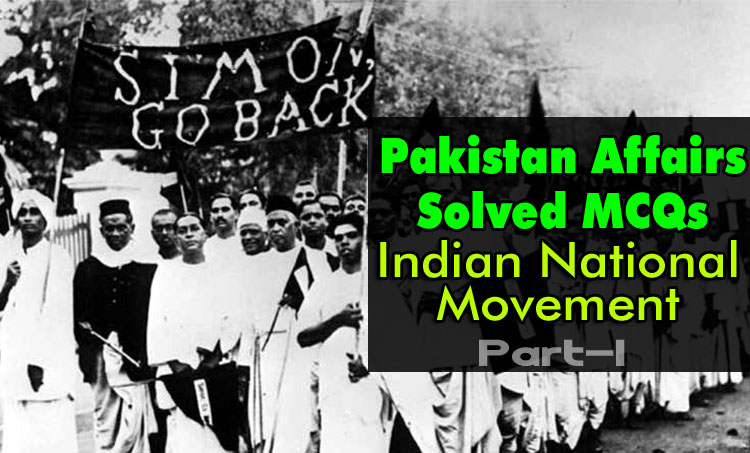
Indian National Movement | Pakistan Affairs Solved MCQs For Competitive Exams Part-I

Pakistan Affairs Solved MCQs
Indian National Movement
For FPSC, PCS, PMS, NTS, OTS, and all other Competitive Exams

1. The Asiatic Society was established in Calcutta by:
(a) Warren Hastings
(b) Sir William Jones
(c) Raja Ram Moham Roy
(d) T. B. Macaulay
Answer: B

2. Brahmo Samaj mainly insisted upon:
(a) Abolition of Satti
(b) Monotheism
(c) Child marriage
(d) Reintroduction of converted Hindus
Answer: B

3. Al-Hilal weekly was started by:
(a) Abul Kalam Azad
(b) Nehru
(c) Gandhi
(d) Iqbal
Answer: A

4. Which of the following Indian states was annexed by Lord Dalhousie on the pretext of maladministration?
(a) Nagpur
(b) Oudh
(c) Hyderabad Deccan
(d) None of these
Answer: B

5. The introduction of cooperative credit societies in India was first suggested in report of 1892 to the Government of Madras by:
(a) Anthony McDonald
(b) George Padison
(c) Maclegan
(d) Nicholson
Answer: A

Categories
CSS Videos Current Affairs

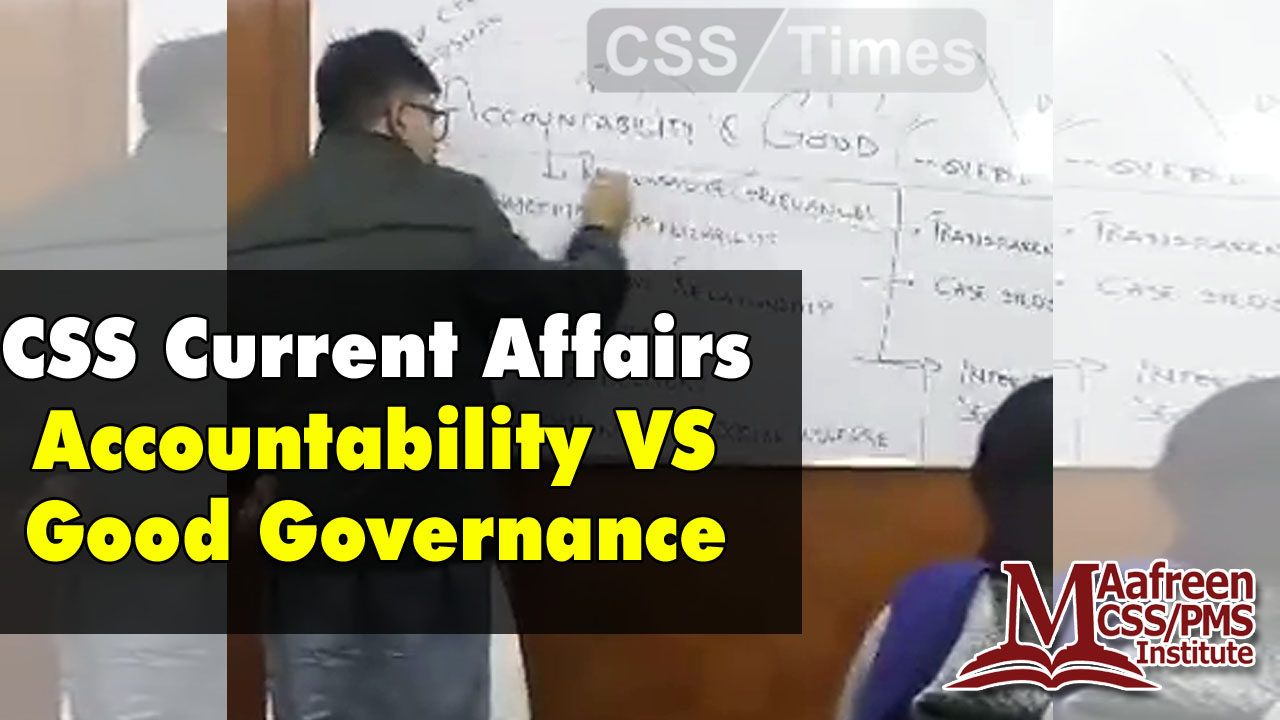
Accountability VS Good Governance | CSS Times Video Lectures

CSS Current Affairs Video Lecture
Accountability VS Good Governance

1st Lecture of Current Affairs for 2020 Session

Mr. Hussain Sardar (Additional Secretary Punjab) delivering Lecture on ” Good Governance vs Accountability and Terrorism” at Aafreen CSS/PMS Institute in collaboration with CSS Times (www.csstimes.pk).

Lecture Date : January 28, 2019.

Venue: Aafreen CSS Institute, D-2 Seabreeze Homes Shershah Block,
Garden Town. Behind Barket Market, Lahore.
for details Contact 03214991005

Watch the Complete Lecture Video below:

Categories
CSS Notes CSS Optional subjects FPSC CSS Past Papers 2016 FPSC CSS Past Papers 2017

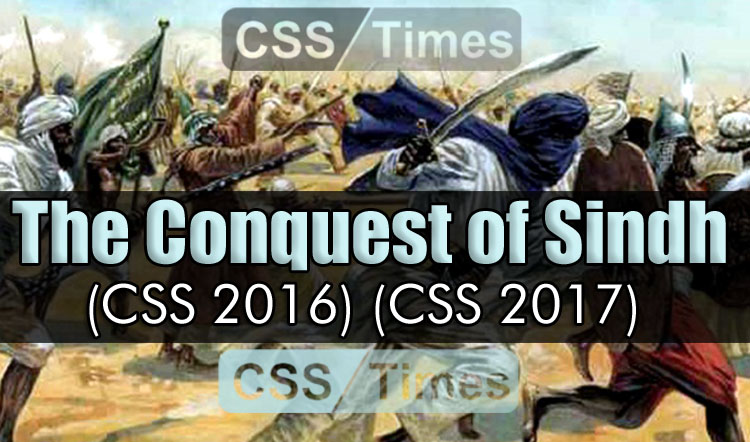
The Conquest of Sindh (CSS 2016-2017 & CSS Paper Solved)

The Conquest of Sindh (CSS 2016-2017 & CSS Paper Solved)

The conquest of Sindh, located in today’s Pakistan, happened in stages. During the Caliphate of Omar ibn al Khattab, Muslim armies approached the coast of Makran, but Omar withdrew the troops in response to reports of a harsh and inhospitable terrain. Emir Muawiya subdued eastern Afghanistan and the Northwest Frontier areas. However, it was not until the reign of Walid I (705-713) that much of what is today Pakistan was brought under Muslim rule.

Categories
GK MCQ’s MCQs Pakistan Affairs

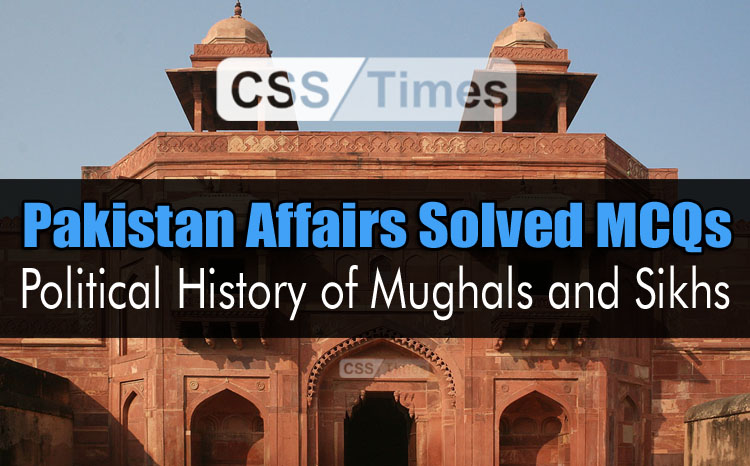
Pakistan Affairs Solved MCQs (Political History of Mughals and Sikhs) For Competitive Exams

Pakistan Affairs Solved MCQs
Political History of Mughals and Sikhs
For FPSC, PCS, PMS, NTS, OTS, and all other Competitive Exams

1. Who united all Sikhs and founded kingdom in Punjab?
(a) Guru Nanak
(b) Maharaja Ranjit Singh
(c) Guru Gobind Singh
(d) None of these
Answer: B

2. The Mansabdari system introduced by Akbar was borrowed from the system in:
(a) Turkey
(b) Persia
(c) Mongolia
(d) Afghanistan
Answer: C

3. Who among the following was the first Mughal emperor to allow Britishers to establish trade links with India?
(a) Akbar
(b) Jehangir
(c) Aurangzeb
(d) Shah Jahan
Answer: B

4. The capital of Mughal empire was shifted from Agra to Delhi by:
(a) Jehangir
(b) Aurangzeb
(c) Shah Jahan
(d) Humayun
Answer: C

Categories
GK MCQ’s MCQs Pakistan Affairs

Pakistan Affairs Solved MCQs (Marathas and Coming of the Europeans) For Competitive Exams

1. When did Vasco da Gama come to India?
(a) 1490
(b) 1492
(c) 1493
(d) 1498

2. The Marathas chief, Sambhagi was executed during the reign of:
(a) Jehangir
(b) Aurangzeb
(c) Shah Jahan
(d) Mahabat Khan

3. The beginning of the British political sway over India can be traced to the battle of:
(a) Buxar
(b) Plassey
(c) Wandiwash
(d) Panipat

4. Who was the ruler of an Indian state who allied himself with France?
(a) Nizam-ul-Mulk Asif Jah
(b) Tipu Sultan
(c) Saadat Khan
(d) Akbar

Categories
GK MCQ’s MCQs Pakistan Affairs

Cultural History | Pakistan Affairs Solved MCQs For FPSC Exams

Cultural History
Pakistan Affairs Solved MCQs
For all kind of FPSC Exams

1. Amir Khusro’s name is associated with the invention of:
(a) Sarod
(b) Sitar
(c) Tabla
(d) Shehnai

2. The most famous court poet of Akbar was:
(a) Abdur Rahim Khan-i Khanah
(b) Tulsidas
(c) Raskhan
(d) Surdas

3. Who among the following Mughal rulers has been called as the “Prince of Builders”?
(a) Jehangir
(b) Akbar
(c) Babur
(d) Shah Jahan

Categories
GK MCQ’s MCQs Pakistan Affairs

Pakistan Affairs Solved MCQs for FPSC Exams (History of the Subcontinent)

History of the Subcontinent
Pakistan Affairs Solved MCQs
For all kind of FPSC Exams

1. The main characteristics of the Indus valley civilisation is:
(a) Drainage System
(b) Town planning
(c) Pucca houses
(d) Well laid-out roads

2. The main occupation of the people of the Indus valley was:
(a) Trade
(b) Agriculture
(c) Cattle rearing
(d) Hunting

3. Which one of the following archeologists initially discovered the Mohenjodaro site of the Indus Valley Civilisation?
(a) Sir John Marshal
(b) Rakhal Das Banerjee
(c) Daya Ramshani
(d) Sir Martimer Wheeler

4. Which one of the following elements of Hinduism were practised in the Indus valley civilisation?
(a) Idol worship
(b) Wearing of sacred threads
(c) Cult of Shiva
(d) None of these