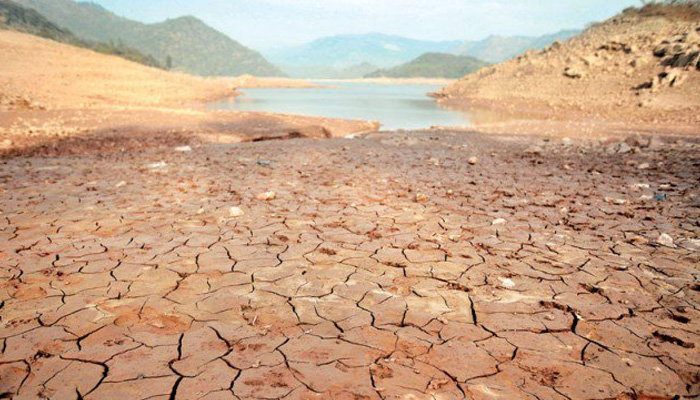
Pakistan could “run dry” by 2025 as its water shortage is reaching an alarming level. The authorities remain negligent about the crisis that’s posing a serious threat to the country’s stability, DW reports.
According to a recent report by the International Monetary Fund (IMF), Pakistan ranks third in the world among countries facing acute water shortage. Reports by the United Nations Development Programme (UNDP) and the Pakistan Council of Research in Water Resources (PCRWR) also warn the authorities that the South Asian country will reach absolute water scarcity by 2025. “No person in Pakistan, whether from the north with its more than 5,000 glaciers, or from the south with its ‘hyper deserts,’ will be immune to this scarcity,” said Neil Buhne, UN humanitarian coordinator for Pakistan.
Researchers predict that Pakistan is on its way to becoming the most water-stressed country in the region by the year 2040. It is not the first time that development and research organisations have alerted Pakistani authorities about an impending crisis, which some analysts say poses a bigger threat to the country than terrorism says DW in its report on water issue in Pakistan.
In 2016, PCRWR reported that Pakistan touched the “water stress line” in 1990 and crossed the “water scarcity line” in 2005. If this situation persists, Pakistan is likely to face an acute water shortage or a drought-like situation in the near future, according to PCRWR, which is affiliated with the South Asian country’s Ministry of Science and Technology.
The topic under discussion is very critical, sensitive and it demands a lot of attention. As it is crystal clear to the world Israel is an illegal country and the entire inhabitant settler Jews in Israel have usurped the land from Palestinians. If we dare to have a meditative look in the recesses of history, it will dawn upon us that that the British in 1948 committed this heinous crime of letting the Jews settle in Philistine. Behind the creation of Philistine Dispute as well that of Kashmir, vicious masked face of the British is involved. Apparently, they pretend to be a torch bearer, but as a matter of fact, they are imperialist exploiters who leave no stone unturned ever to put the Muslims and the Muslim Ummah in deep abyss of sufferings and problems.
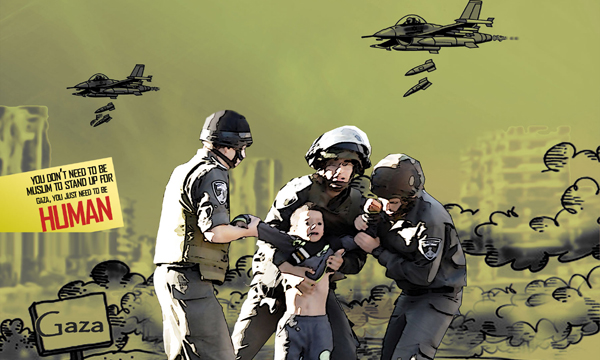
In Gaza Strip, the humiliating crimes of Israel are continue unabated. Infants are being massacred mercilessly. The homes of Palestinians are turned into battlefields and where the childhood of innocent Palestinians children is surrounded by the vicious shadows of missiles. Humanity is at pains there. The painful cries of innocent Palestinians children, women and men are very heart rending. If Hamas as a result of brutish attacks of Israeli Palestinian shows some sort of resistance, its responsibility is put to the innocent Palestinians and Israeli army in a ferocious way butchers the Palestinians on large scale and their houses are demolished.
The topic under discussion is very critical, sensitive as well as having enormous importance. If the opinion of world is taken, it is very discouraging and pinching because most of the European countries rather most of the countries of the world have the conception that Pakistan is corrupt country and if she is not provided with external aid, she will collapse. Even the Americans think that Pakistan is massively dependent on them because of this imperialistic thinking America has left no stone unturned ever in maltreating and threatening Pakistan even in critical and sensitive circumstances. Same is the case with India although Indians are our neighbor yet they have always been showing enmity against Pakistan. From the inception of Pakistan they have always chalked out evil designs to harm Pakistan. The Indians reckon that Pakistan will become bankrupt and soon it will collapse but it has never happened Pakistan has survived and it will still survive.
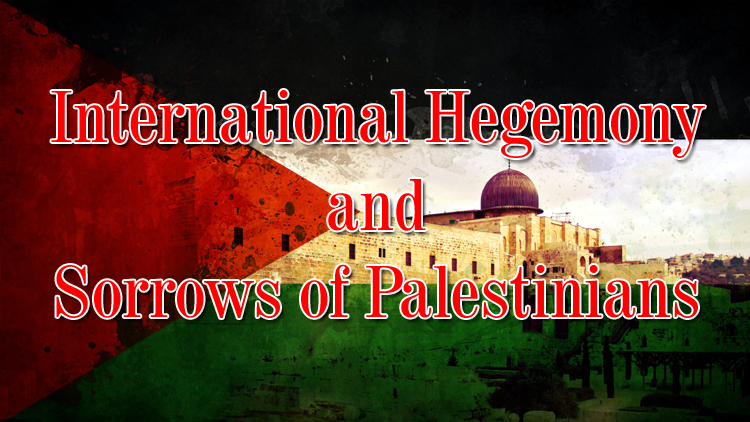
International Hegemony and Sorrows of Palestinians
Palestine pledge called for international protection through OIC.
Leaders of Muslim nations have called for an international force to protect Palestinians, following the killing of more than 60 protesters by Israeli forces in Gaza.An extraordinary summit of the Organization of Islamic Cooperation in Istanbul voiced determination to take action against countries moving embassies to Jerusalem, as the US has done.
The Israeli–Palestinian conflict is the ongoing struggle between Israelis and Palestinians that began in the mid-20th century.The origins to the conflict can be traced back to Jewish immigration, and sectarian conflict in Mandatory Palestine between Jews and Arabs.It has been referred to as the world’s “most intractable conflict”, with the ongoing Israeli occupation of the West Bank and the Gaza Strip reaching 51 years.
Many attempts have been made to broker a two-state solution, involving the creation of an independent Palestinian state alongside the State of Israel (after Israel’s establishment in 1948). In 2007, the majority of both Israelis and Palestinians, according to a number of polls, preferred the two-state solution over any other solution as a means of resolving the conflict.Moreover, a majority of Jews see the Palestinians’ demand for an independent state as just, and thinks Israel can agree to the establishment of such a state.The majority of Palestinians and Israelis in the West Bank and Gaza Strip have expressed a preference for a two-state solution.Mutual distrust and significant disagreements are deep over basic issues, as is the reciprocal scepticism about the other side’s commitment to upholding obligations in an eventual agreement.
Within Israeli and Palestinian society, the conflict generates a wide variety of views and opinions. This highlights the deep divisions which exist not only between Israelis and Palestinians, but also within each society. A hallmark of the conflict has been the level of violence witnessed for virtually its entire duration. Fighting has been conducted by regular armies, paramilitary groups, terror cells, and individuals. Casualties have not been restricted to the military, with a large number of fatalities in civilian population on both sides. There are prominent international actors involved in the conflict.
The two parties engaged in direct negotiation are the Israeli government, currently led by Benjamin Netanyahu, and the Palestine Liberation Organization (PLO), currently headed by Mahmoud Abbas. The official negotiations are mediated by an international contingent known as the Quartet on the Middle East (the Quartet) represented by a special envoy, that consists of the United States, Russia, the European Union, and the United Nations. The Arab League is another important actor, which has proposed an alternative peace plan. Jordan, having relinquished its claim to the West Bank in 1988 and holding a special role in the Muslim Holy shrines in Jerusalem, has also been a key participant.
Since 2006, the Palestinian side has been fractured by conflict between the two major factions: Fatah, the traditionally dominant party, and its later electoral challenger, Hamas. After Hamas’s electoral victory in 2006, the Quartet conditioned future foreign assistance to the Palestinian National Authority (PA) on the future government’s commitment to non-violence, recognition of the State of Israel, and acceptance of previous agreements. Hamas rejected these demands, which resulted in the Quartet’s suspension of its foreign assistance program, and the imposition of economic sanctions by the Israelis.A year later, following Hamas’s seizure of power in the Gaza Strip in June 2007, the territory officially recognized as the PA was split between Fatah in the West Bank, and Hamas in the Gaza Strip. The division of governance between the parties had effectively resulted in the collapse of bipartisan governance of the PA. However, in 2014, a Palestinian Unity Government, composed of both Fatah and Hamas, was formed. The latest round of peace negotiations began in July 2013 and was suspended in 2014.
The 1956 Suez Crisis resulted in a short-term Israeli occupation of the Gaza Strip and exile of the All-Palestine Government, which was later restored with Israeli withdrawal. The 1967 Six-Day War exerted a significant effect upon Palestinian nationalism, as Israel gained military control of the West Bank from Jordan and the Gaza Strip from Egypt.
The first Palestinian uprising began in 1987 as a response to escalating attacks and the endless occupation. By the early 1990s, international efforts to settle the conflict had begun, in light of the success of the Egyptian–Israeli peace treaty of 1982.
The tensions between Israel and Hamas escalated until late 2008, when Israel launched operation Cast Lead upon Gaza, resulting in thousands of civilian casualties and billions of dollars in damage. By February 2009, a ceasefire was signed with international mediation between the parties, though the occupation and small and sporadic eruptions of violence continued.
In 1993, Israeli officials led by Yitzhak Rabin and Palestinian leaders from the Palestine Liberation Organization led by Yasser Arafat strove to find a peaceful solution through what became known as the Oslo peace process.
The peace process has been predicated on a “two-state solution” thus far, but questions have been raised towards both sides’ resolve to end the dispute.An article by S. Daniel Abraham, an American entrepreneur and founder of the Center for Middle East Peace in Washington, US, published on the website of the Atlantic magazine in March 2013, cited the following statistics: “Right now, the total number of Jews and Arabs living … in Israel, the West Bank, and Gaza is just under 12 million people. At the moment, a shade under 50 percent of the population is Jewish.”
Israel has had its settlement growth and policies in the Palestinian territories harshly criticized by the European Union citing it as increasingly undermining the viability of the two-state solution and running in contrary to the Israeli-stated commitment to resume negotiations.
In December 2011, all the regional groupings on the UN Security Council named continued settlement construction and settler violence as disruptive to the resumption of talks, a call viewed by Russia as a “historic step”.A report published in February 2014 covering incidents over the three-year period of 2011–2013, Amnesty International asserted that Israeli forces employed reckless violence in the West Bank, and in some instances appeared to engage in wilful killings which would be tantamount to war crimes. Besides the numerous fatalities, Amnesty said at least 261 Palestinians, including 67 children, had been gravely injured by Israeli use of live ammunition. In this same period, 45 Palestinians, including 6 children had been killed. Amnesty’s review of 25 civilians deaths concluded that in no case was there evidence of the Palestinians posing an imminent threat. At the same time, over 8,000 Palestinians suffered serious injuries from other means, including rubber-coated metal bullets.
According to a May 2011 poll carried out by the Palestinian Center For Public Opinion that asked Palestinians from the Gaza Strip and the West Bank including East Jerusalem, “which of the following means is the best to end the occupation and lead to the establishing of an independent Palestinian state”, 5.0% supported “military operations”, 25.0% supported non-violent popular resistance, 32.1% favored negotiations until an agreement could be reached, 23.1% preferred holding an international conference that would impose a solution on all parties, 12.4% supported seeking a solution through the United Nations, and 2.4% otherwise.
Despite a long-term peace process and the general reconciliation of Israel with Egypt and Jordan, Israelis and Palestinians have failed to reach a final peace agreement. The key issues are mutual recognition, borders, security, water rights, control of Jerusalem, Israeli settlements, Palestinian freedom of movement, and Palestinian right of return. The violence of the conflict, in a region rich in sites of historic, cultural and religious interest worldwide, has been the object of numerous international conferences dealing with historic rights, security issues and human rights, and has been a factor hampering tourism in and general access to areas that are hotly contested.
Israel is acting like a terrorist and breaching UN resolutions of Peace which is totally unacceptable.Oslo Accord is a workable solution.World Leaders are needed to let the peace win over conflicts and violence.
Watch Video: 25 Preparation Tips on How to Study for CSS at home
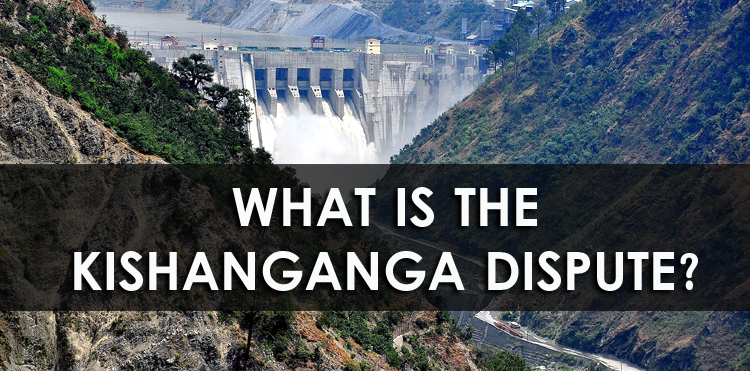
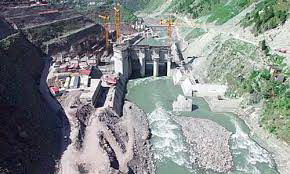
THE dispute revolves around a hydroelectric power plant on the Kishanganga River, which is a tributary of the Jhelum and is known as the Neelum in Pakistan.
On May 19, 2018, Indian Prime Minister Narendra Modi inaugurated the project -which includes a dam on the tributary-barely metres away from the Line of Control in the disputed Kashmir region.
The project will generate 1,713 million units of electricity per year. The dam will divert Jhelum waters to an underground power house. To do so, it will transfer the water from the Gurez Valley back into mainland Kashmir, instead of allowing it to flow into Pakistan.
The Kishanganga River flows through the regions of Neelum in AJK and Astore before entering the India-held region of Gurez. The dam will give India control over a river that flows from Pakistan into India-held Kashmir and then re-enters Pakistan.
Non-state actors (NSA) are entities that participate or act in international relations. They are organizations with sufficient power to influence and cause a change even though they do not belong to any established institution of a state.
The admission of non-state actors into international relations theory conflicts with the assumptions of realism and other black box theories of international relations, which argue that interactions between states are the main relationships of interest in studying international events.
Governor General of British India (Indo-Pak Subcontinent)
Warren Hastings (1772-1785) | Governor General of British India
First Governor General of India. By the Regulating Act of 1773, brought the Dual government system to an end. Zamindars were given judicial powers; establishment of civil and criminal courts in each district. In 1781, he founded the Calcutta Madrasa, for promotion of Islamic studies. He founded the Asiatic Society of Bengal with William Jones in 1784. | Governor General of British India
Sir John Macpherson (1785-1786)
He held the post temporarily
Lord Cornwallis (1786-1793)
Introduced Permanent Settlement of Bengal (also called Zamindari system). It was an agreement between East India Company and Bengali landlords to fix revenues to be raised from land. He introduced Police reforms according to which each district was divided into 400 square miles and placed under a police superintendent. Introduction of Civil Services in India. | Governor General of British India
Sir John Shore (1793-1798)
He followed policy of non-intervention. Introduced Charter Act of 1793 | Governor General of British India
Simple Ways to Memorise All the Current Affairs & GK for Competitive Exams
Asslam-o-Elikum and welcome to CSSTimes.pk. A lot of Aspirants have asked us…… How to get ready for General Knowledge and Current Affairs for the CSS Exams and all other Competitive Exams.
So I am sharing 4 possible Ways to reading and memorize Current Affairs and General Knowledge!
Before we set in motion you have to keep in mind a few important points regarding this:
In order to retain information about General Knowledge and Current Awareness for coming exams, constantly make sure your PERCEPTION is 100 percent clear about this.
Keep on the track and you will end up where you want to be. Never miss reading newspaper or current affairs more than a week.
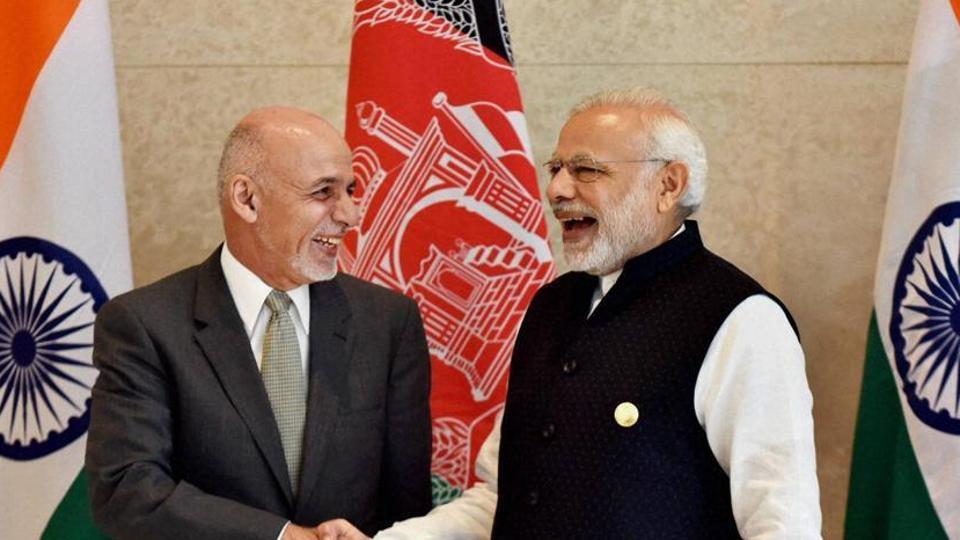
Why India wants more presence in Afghanistan | CSS Current Affairs
The enemy of an enemy is always a friend. In our field of study this can be termed as a strategic partner or an ally. That is the sort of relationship India is trying to build with Afghanistan. Our next door neighbour in the West is India’s dream ‘backdoor entrance’ into Pakistan. It’d be ideal for the Indians to manipulate the Afghan-Pakistan situation to their favour by buying the Afghan loyalty and using it against their one true enemy. However, unfortunately for India, we do not live in Narnia and things are not as magically easy as they would want them to be. The situation might seem to be in favour of the Indians at present since they have managed to build cordial relations with Afghanistan but it can’t be understated that an Afghanistan minus Pakistan is not possible.
Let’s take a step back and discuss things objectively. There is no doubt about the fact that there is only one thing common amongst the otherwise divided Afghan government and that is their blame for Pakistan. They blame us for their problems. These allegations are obviously baseless but that is something to be discussed in another debate. Right now the aspect that needs to be focused on is that the Indians have no brotherly affiliation or cultural proximity with the Afghans, unlike Pakistan. They are merely trying to use their land as a playground for their massacre intended for Pakistan. Undoubtedly they are smart about it as we all know strategic planning with a hint of negativity is a part of India’s skill set and they feel no shame in using it anywhere and everywhere. Their $200 million aid to be spread over the future five years is not a step to help Afghanistan stand up on its own feet in terms of education, infrastructure, health and other aspects of a state. This is actually their attempt to have a more dependent state that comes running to India in all times of need. One can simply not ignore the wish of their Godfather and the Afghans will be no exception.
They blame Pakistan for using their land in war to gain favours from the Americans but the question is, why love India when that is exactly what they are doing as well? India is only strengthening Afghanistan up to the extent where it is stable enough to be used and manipulated against Pakistan. Yes, they are investing in their institutions in the present scenario but that is only so that they can reap what they sow in the past. There is one single reason why India wants more presence in Afghanistan, to threaten Pakistan from both sides when the time comes. It seems like all of India’s military and conventional strategies seem to be revolving around Pakistan’s lack of strategic depth. Their self-declared victory bound Cold Start Doctrine and their other regional pursuits like this venture in Afghanistan all revolves around the single advantage they have and that is Pakistan’s narrow territory. What they don’t realize is that this can and will be used in our favour as well when the time demands it.
However, despite India’s wishes and hopes there are some important factors that cannot be avoided when talking about the Pak-Indo-Afghan triangle. One of the major factors here is the ethnic, cultural and religious similarities that Afghanistan and Pakistan share. The Pashtun element between the two states is very strong and although India tries its best to maneuver this situation and highlight the aspect in negative light to create a rift between the two states and their people, this is not an easy goal to achieve. Pakistan and Afghanistan go long back and here it must be admitted that there is a certain degree of bitter taste and skepticism between the two states but that is something that can be resolved through dialogue and other diplomatic channels. Given all of that the only hurdle or might we say the only force stopping this from happening is the neighbour next door with rapidly growing hegemonic ambitions. They are willing to compromise the security and stability of the region to achieve their selfish desires and this is the only reason why they want more presence in Afghanistan.
Essay Outline: Economic Challenges Faced by Pakistan
It is an open secret that writing standard English and grammatical accuracy play a vital role in success in essay writing for CSS Exam. You should know the art of literary and scholarly writing. It needs a long discussion to expatiate about improving written English but let me give you some rudimentary tips. A basic attribute which is to learn idiomatic usage in writing an essay should be developed. For earning grammatical accuracy in your writing, study English grammar thoroughly (not cursorily) to learn the correct usage of grammatical units i.e. verbs, adverbs, adjective, coordination, subordination, subject-verb agreement, phrasal verbs etc.
Outline
Maximum Size 2.5 Pages
Minimum Size 1.5 Pages
Your outline should be strictly adhered to the topic so that if one reads your Outline without knowing the topic he should reach the topic himself. This is the mirror test of a good outline.
You can use Headings and Sub Headings but keep it in mind make it as lengthy as manageable within time. Too long outline will require time for expansion and closure. You can trim you essay outline if it is too lengthy. But is should not be too short as well.
Your Outline has an effect on the examiner about you.