Daily Top-20 MCQs for CSS (Set-20)
for CSS, PMS, PCS, FPSC and related Exams
Today’s MCQs are all about Political Science (Introduction to Political Science), these MCQs are taken from different books and Past Papers which are helpful for all type competitive exams.
Which one of the following statements aptly describes the basis of the cabinet system of government?
(a) The cabinet works on the system of collective responsibility.
(b) The cabinet is responsible to the people
(c) The cabinet government is a majority government.
(d) The cabinet government is a party government.
Answer: c
Which one of the following would be called electorate in a country having universal adult franchise?
(a) The total population of; the citizens of a state.
(b) The total population of the citizens of a state excluding women and children.
(c) The total population of adult citizens of the state
(d) The total population of adult citizens of the state excluding lunatics and criminals.
Answer: d
Which concept of the state considers it to be an all-comprehensive, all-powerful and all-embracing institution?
(a) The ethical notion of state
(b) The legal notion of state
(c) The welfare notion of state
(d) State as an organic unit
Answer: a
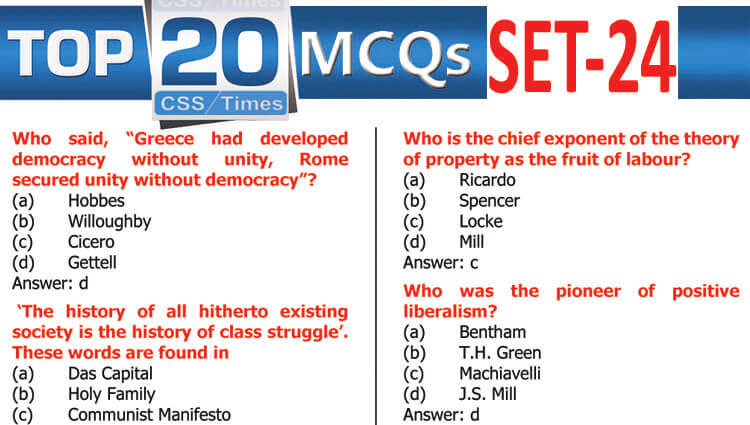
Who is the chief exponent of the theory of property as the fruit of labour?
(a) Ricardo
(b) Spencer
(c) Locke
(d) Mill
Answer: c
Who was the pioneer of positive liberalism?
(a) Bentham
(b) T.H. Green
(c) Machiavelli
(d) J.S. Mill
Answer: d
When it is said that rights are not a solute, it means that they
(a) are available without any restrictions to some sections of society only
(b) are available only to some people in society
(c) are subject to only reasonable restrictions imposed in the interest of society
(d) are hedged in by lot of restrictions in the interest of various sections of society
Answer: c
Who said, “Greece had developed democracy without unity, Rome secured unity without democracy”?
(a) Hobbes
(b) Willoughby
(c) Cicero
(d) Gettell
Answer: d
‘The history of all hitherto existing society is the history of class struggle’. These words are found in
(a) Das Capital
(b) Holy Family
(c) Communist Manifesto
(d) Poverty of Philosophy
Answer: c
Hobbes, Locke and Rousseau
(a) advocated the social contract theory
(b) agreed about the conditions in the state of nature
(c) discredited the concept of natural rights.
(d) rejected the doctrine of state sovereignty
Answer: a
According to the pluralist theory of democracy
(a) political power is shared by the state and non-political associations and interest groups
(b) people participate in politics with the express aim of overcoming their alienation from the groups to which they belong
(c) the politics of consensus is not feasible
(d) the power of individuals should be organised into syndicates and guilds to counter state power
Answer: a
A group of persons organised for a common end which is realised by the cooperative efforts of its members is known as a/an
(a) party
(b) corporation
(c) caucus
(d) association
Answer: a
Who among the following formulated the notion of power/knowledge?
(a) Michel Foucault
(b) Roger Bacon
(c) Socrates
(d) Niccolo Machiavelli
Answer: a
Balance of power refers to
(a) An implicit understanding among several rulers of great powers that the perpetuation of the existing power distribution benefits them mutually
(b) A situation in which nuclear powers threaten mutual annihilation
(c) A just equilibrium in power among the members of the family of nations
(d) All of above
Answer: d
Who among the following theorists advocated participatory democracy?
(a) F.A. Hayek
(b) C.B. Macpherson
(c) Michael Oakeshot
(d) Gaetano Mosca
Answer: b
Who among the following has described democracy as “that institutional arrangement for arriving at political decisions in which individuals acquire the power to decide by means of a competitive struggle for the People’s vote”?
(a) Robert Dahl
(b) Peter Bachrach
(c) C. Wright Mills
(d) Joseph Schumpeter
Answer: d
Who among the following has described the world wide triumph of liberal democracy as the end of history?
(a) Samir Amin
(b) David Held
(c) Francis Fukuyama
(d) Samuel P. Huntington
Answer: c
Most of the Third world states are
(a) Ethnically and culturally divided
(b) Linguistically homogeneous
(c) Rich in natural resources
(d) Economically self-reliant
Answer: a
In a parliamentary form of government, ministers are appointed by
(a) The head of the state at his discretion
(b) The head of the government
(c) The head of the state on the recommendations of the head of the government
(d) The legislature
Answer: c
An Authoritarian State is one which
(a) Guarantees conditions in which the individual can realize his true self
(b) Commands unquestioning obedience to the authority of the ruler
(c) Claims to regulate every sphere of the individual’s life and activity
(d) Is a natural organisation possessing a will of its own to promote the good life
Answer: b
The practice adopted by the party in power to reward its members and supporters through government contracts and jobs is called
(a) Division of powers
(b) Implied powers
(c) Power politics
(d) Spoils system
Answer: d
Check more related MCQs
[catlist name=”MCQs”]