Categories
General Science & Ability Notes

Artificial Intelligence (AI) | CSS General Science & Ability Notes

What is artificial intelligence (AI)? (CSS-2016)

Back in the 1950s, the fathers of the field Minsky and McCarthy, described artificial intelligence as any task performed by a program or a machine that, if a human carried out the same activity, we would say the human had to apply intelligence to accomplish the task.

According to the father of Artificial Intelligence, John McCarthy, it is “The science and engineering of making intelligent machines, especially intelligent computer programs”.

Artificial Intelligence is a way of making a computer, a computer-controlled robot, or a software think intelligently, in the similar manner the intelligent humans think.

AI is accomplished by studying how human brain thinks, and how humans learn, decide, and work while trying to solve a problem, and then using the outcomes of this study as a basis of developing intelligent software and systems.

Categories
CSS Notes World General Knowledge

What Is the FATF (Financial Action Task Force)?

The Financial Action Task Force (FATF) is an intergovernmental organization that designs and promotes policies and standards to combat financial crime. Recommendations created by the Financial Action Task Force (FATF) target money laundering, terrorist financing, and other threats to the global financial system. The FATF was created in 1989 at the behest of the G7 and is headquartered in Paris.

KEY TAKEAWAYS

  • The Financial Action Task Force, or FATF, was originally started to combat money laundering. It has been expanded to also target the financing for weapons of mass destruction, corruption, and terrorist financing.
  • The task force was started in 1989 in Paris, where it is still called the Groupe d’action Financière.
  • Almost all developed countries support or are members of the FATF.
Categories
Pakistan Affairs Notes

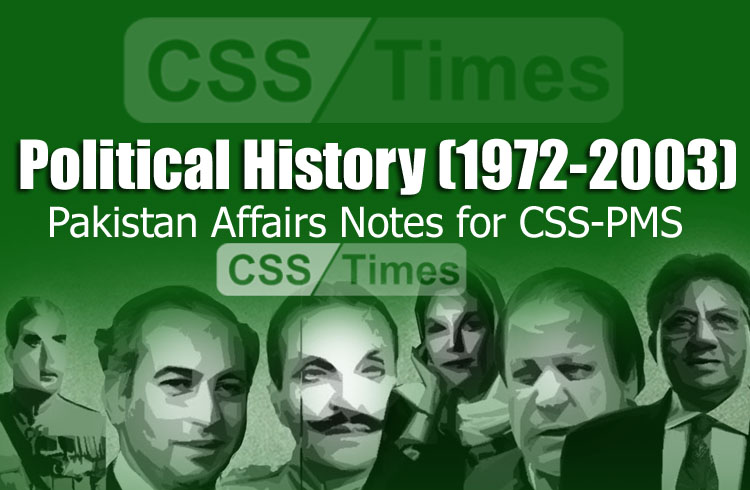
Pakistan Political History (1972-2003) | Pakistan Affairs Notes for CSS-PMS

Pakistan Political History (1972-2003) | Pakistan Affairs Notes for CSS-PMS

1: Pakistan Political History 1972-1977:

Z. A. Bhutto assumed power on December 20, 1971. First he became President of Pakistan and also the first civilian Chief Marshal Law Administrator. Pakistan Political History

Major Policies

The first task was the Constitution making. In 1972 Interim Constitution was adopted and then the

Parliament of Pakistan unanimously adopted 1973 Constitution, Pakistan Political History.

The major policy of Mr. Bhutto was Nationalisation. His government nationalised:

  1. Emerald mines in Swat
  2. Key industries like Iron & Steel, Basic metals, heavy engineering, heavy electrical, Motor Vehicles & Tractors, Heavy & Basic Chemicals, Petro- Chemicals, Cement, Gas, Oil Refinery etc.
  3. Life Insurance in 1972
  4. Banks in 1974
  5. Schools and Colleges in 1972. New University Ordinance was issued in 1973.
  6. Managing and sub-agencies were abolished.
Categories
Pakistan Affairs Notes

Pakistan Political History (1947-1971) | Pakistan Affairs Notes for CSS-PMS

Pakistan Political History (1947-1971) | Pakistan Affairs Notes for CSS-PMS

1: First Eleven Years (1947-58)

Pakistan won independence under extremely difficult conditions. The next task was setting up of a new state.

There was no administrative structure. Riots, refugee’s problem and economic pressures were challenging for the new state.

Negative attitude from Indian government and war on Kashmir created problems in relations with India.

Categories
Gender Studies Gender Studies MCQs

Gender Studies Short Q/A | (Deconstruction of Cultural and Structural Forms of Violence)

Gender Studies Short Q/A
(Deconstruction of Cultural and Structural Forms of Violence)

What is honour-based violence (HBV)?

Honour-based violence is a phenomenon where a person (most often a woman) is subjected to violence by her collective family or community in order to restore ‘honour’, presumed to have been lost by her behaviour, most often through expressions of sexual autonomy.

Categories
Pakistan Affairs Notes

The 1973 Constitution | Pakistan Affairs Notes for CSS-PMS

The 1973 Constitution | Pakistan Affairs Notes for CSS-PMS

1. Background
2. Constitution Making
3. Features

1. Background

Abrogation of the 1962 Constitution on March 25, 1969 led to second martial law in the country. Yahya Khan handed over power to Zulfikar Ali Bhutto on December 20, 1971 after the first general elections. But martial law continued and there was no constitution.

National Assembly approved an Interim Constitution, which was enforced on April 21, 1972.

2: Constitution Making

Constitutional Committee comprising National Assembly (NA) members from all parties was set up in April 1972. Law Minister was the Chairman of this Committee.

All parties agreed on the future political system in October 1972. The Committee reported on December 31, 1972. After long deliberations and compromises final draft was approved unanimously on April 10, 1973. The new Constitution was enforced on August 14, 1973.

The Constitution functioned since then with two gaps. It remained operational during following periods:

Categories
General Science & Ability Notes

‘Artificial Intelligence’ for humanity | General Science & Ability Notes

Q: What is ‘Artificial Intelligence’?
How is it helpful for humanity? (CSS-2018)

Artificial Intelligence is a way of making a computer, a computer-controlled robot, or a software think intelligently, in the similar manner the intelligent humans think.

AI is accomplished by studying how human brain thinks, and how humans learn, decide, and work while trying to solve a problem, and then using the outcomes of this study as a basis of developing intelligent software and systems.
‘Artificial Intelligence’ for humanity

Artificial intelligence helps farmers, doctors and rescue workers make a positive impact on society.

Categories
Pakistan Affairs Notes

The 1962 Constitution | Pakistan Affairs Notes for CSS-PMS

The 1962 Constitution | Pakistan Affairs Notes for CSS-PMS

1: Background

Military took over on 7 October 1958 and consequently Ayub Khan became Chief Martial Law Administrator. One major task was to frame a new Constitution. The administration was critical of Parliamentary system because it caused instability in the past. They sought stability of the nation in the gradual development of democracy.

2: 1962 Constitution Making

The government introduced Basic Democracies in October 1959. Under this system Forty Thousand basic democrats (local councilors) were to be elected in each province. They have to perform functions as local government and their role in developmental work. They also acted as an electoral college for the election of president and the national assembly.

Elections for the Basic Democracies (BD) were held in December 1959 and January 1960. Then Presidential referendum was held by the elected BD members on February 17, 1960. A Constitutional Commission was established in February 1960 under the chairmanship of Justice Shahabuddin, former Chief Justice. The tasks assigned to the Commission were:

Categories
Gender Studies

Gender Studies | Problematizing the Category of “Sex” Queer Theory

Problematizing the Category of “Sex” Queer Theory | CSS Gender Studies Notes

Queer Theory

One is not born a woman, but rather becomes one.
—Simone de Beauvoir

The origin of uncomfortable conversations draw attention of individuals towards the real myth behind the Queer theory that has been a glaring topic in the community since its inception. The conceptual framework is not only stuck with the issues as per the required plan of action in the way. The anthology that focuses on the various debates are the best by product with other concepts as society needs. Many debates and topics has been introduced in the manner that exactly required to initiate the way in respective manner.

The important issues that has been a debate regarding the elements as the intimacy, privacy and even as the sex harassment that has been a normal topic to discuss with all formalities. The concept initialization regarding the sex and even the other elements in the gender studies are not the product of abrupt decision in gender studies. Oppositely, it has been an issue since the inception of gender and conception of gender linkage with the society. There are possible four major institutions in the society and these institutions always handles the matter of gender that has been using as the Queer theory with the same pace as the gender understand.

Categories
Pakistan Affairs Notes

The 1956 Constitution | Pakistan Affairs Notes for CSS-PMS

The 1956 Constitution | Pakistan Affairs Notes for CSS-PMS

The Constitution of 1956 was passed after long deliberations. It replaced the Interim Constitution. It has 234 Articles and 6 Schedules. It declared that the name of the country would be the Islamic Republic of Pakistan.

There was clear impact of the Government of India Act, 1935 and the Interim Constitution.

Features

1: Parliamentary System

Executive Authority vested in the President who exercised it on the advice of the Prime Minister except in the matters he had discretion.

President had ceremonial functions and exercised limited powers.

The President would be of 45 years of age, Muslim and qualified to be a member of National Assembly.

He was to be elected by National Assembly (NA) and Provincial Assemblies.