Categories
CSS Notes CSS Optional subjects Gender Studies

Gender Studies Notes | Theories of Social Construction of Gender

CSS Gender Studies Notes

What are the theories of social construction of gender? (CSS-2016)

Social construction is something you might not be aware of. You are somewhat living in segregation depending on what gender, race and class you are. Race, class and gender don’t really mean anything. They only have a meaning because society gives them a meaning. Social construction is how society groups people and how it privileges certain groups over others. For example, you are a woman or a man because society tells you that you are, not because you choose to be. Simple as that. Just like it tells you what race you’re classified as and what social class you belong in. It is all just a social process that makes us differentiate between what’s “normal” and what’s not “normal.”

According to the author of “Night To His Day: The Social Construction of Gender,”, Judith Lorber (born November 28, 1931) is Professor Emerita of Sociology and Women’s Studies at The CUNY Graduate Center and Brooklyn College of the City University of New York.) the social construction of gender begins “with the assignment to a sex category on the basis of what the genitalia look like at birth” When a baby is born, the first thing a doctor does is look at the baby’s genitalia in order to determine whether it will be a boy or a girl; this is the beginning of the gender process of social construction. After they are classified as boy or girl, parents become part of this societal process as they start dressing them with colors that identify their gender. The “normal” thing to do in this case would be for baby girls to be dressed in pink and baby boys to be dressed in blue. It is just not normal to dress your baby boy in pink or your baby girl in blue, right? The reason for this is because society has made colors become a symbol to distinguish boys from girls. After this, as children grow up they start learning how they are supposed to act by observing and imitating the people of the same gender as them; girls should act like their mommy and boys should act like their daddy. Each gender is expected to dress and act in a certain way, but these behaviors then lead to stereotypes.
Categories
CSS Notes Pakistan Affairs Notes

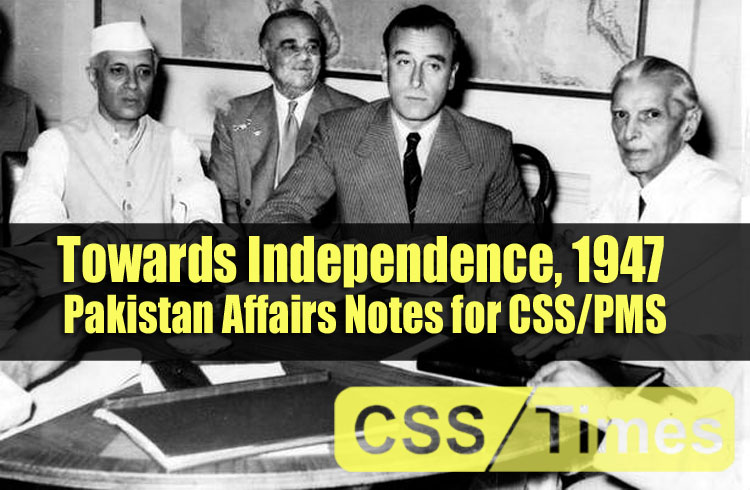
Towards Independence, 1947 | Pakistan Affairs Notes for CSS/PMS

Towards Independence, 1947 | Pakistan Affairs Notes for CSS/PMS

Civil Disobedience Movements:

The ML decided to confront the political situation through the protesting means for the first time. The Congress had been working on these lines but the Muslim leaders considered politics a gentle man’s game. Now when the British government joined hands to oust the Muslims from the constitutional and moral position they decided to launch ‘Direct Action.’ The ML revised its decision rejecting the Cabinet Mission Plan. Direct Action Day (August 16, 1946) was a protest against the British policy of injustice towards the Muslims. The Hindu attacks transmuted the course of the protests and concluded huge life casualties. The Calcutta massacre convinced Lord Wavell to bridge the ML-Congress to some settlement.

Wavell tried to prepare Nehru and Gandhi to coordinate the ML. It was imperative to do because Muslim League (95% seats) refused to join the Legislative Assembly. Congress rejected all the possible offers even from the government. Churchill snubbed the Labour government on the Calcutta riots and the Viceroy requested Jinnah to join the Interim Government that Jinnah accepted. On October 25, 1946, the members of the Executive Council were finalized.

Categories
CSS Notes Pakistan Affairs Notes

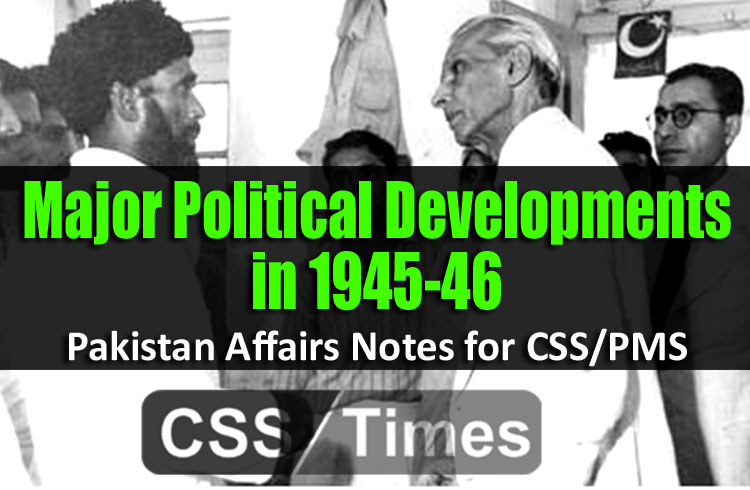
Major Political Developments in 1945-46 | Pakistan Affairs Notes for CSS/PMS

Major Political Developments in 1945-46
Pakistan Affairs Notes for CSS/PMS

Political Situation in 1945

During the World War ll, the British sought Indian military cooperation and offered political and constitutional changes after the war. They desired to expand the Viceroy’s Executive Council.

Lord Wavell arranged Simla Conference during June-July 1945 in which all the political parties participated by sending their representatives. Jinnah and Abul Kalam Azad represented the Muslim League (ML) and the Congress respectively. Maulana Azad claimed Congress as sole representative party of all the peoples living in India. Jinnah considered the ML the only political party of the Indian Muslims and on this the ML had right to appoint Muslim members to the Council. This issue could not be dissolved and the differences between the ML and the Congress increased.

Categories
CSS Notes Pakistan Affairs Notes

The Lahore Resolution, 1940 | Pakistan Affairs Notes for CSS/PMS

The Lahore Resolution, 1940
Pakistan Affairs Notes for CSS/PMS

The experience of Congress Rule compelled the Muslims to launch the movement for separate homeland. The Hindus made them realize that Hindu government would mean an anti-Muslim rule in India. The Muslims’ disappointment from the Congress leadership decided to open a new phase of history. Quaid-i-Azam’s article in Time and Tide concluded that Muslims are a nation. No Constitution can be enforced by ignoring Muslims. His comments on March 13, 1940 are remarkable: “If some satisfactory settlement cannot be found for Muslims in united India, the Muslim will have to demand for division of the country.”

The Lahore Resolution:

The Muslim League held its annual session at Lahore on 22-24 March 1940. The Lahore Resolution was moved by Maulvi Fazlul Haq and seconded by Ch. Khaliquzzaman that finally approved on March 24, 1940. Jinnah rightly expressed his valuable remarks about the political circumstances of India and the Muslims stand. He said:

Categories
CSS Notes Pakistan Affairs Notes

Pakistan Affairs Notes | The Congress Ministries – Policies Towards Muslims

The Congress Ministries – Policies Towards Muslims
Pakistan Affairs Notes for CSS/PMS

Topics:

1. Elections
2. Provincial Governments
3. Their Policies
4. Muslim Response

Government of India Act, 1935:

The Government of India Act, 1935 was not fully promulgated but the only provincial part was introduced in the country. Muslim League and the Congress criticized it but agreed to contest provincial elections.

Categories
CSS Notes Pakistan Affairs Notes

Muslim Politics and Chaudhry Rahmat Ali | Pakistan Affairs Notes for CSS/PMS

Muslim Politics and Chaudhry Rahmat Ali
Pakistan Affairs Notes for CSS/PMS

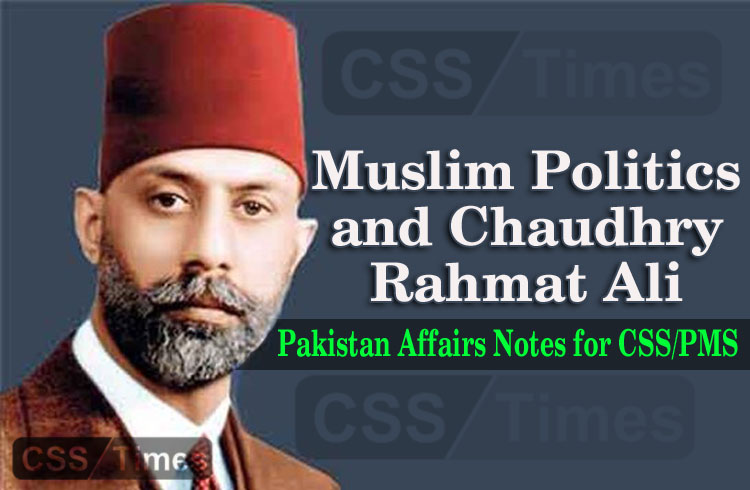
Intellectuals give lines of movement, leaders act upon and the masses prove good soldiers and this way nations accomplish their achievements. Rahmat Ali was one of the eminent scholars who made a significant contribution to the movement for the establishment of Pakistan. He was conscious of Muslim identity and outlined proposals for the partition of India for the sake of Muslims. He was the man who coined the name, PAKISTAN, for the Muslim state. When he first presented his proposal for a Muslim state, nobody took it seriously.

The Muslim intellectuals and leaders were concerned about the future of the Muslims in India. They ensured a secure future for Muslims. For this purpose they worked out various proposals for securing a homeland. Rahmat Ali becomes relevant here.

Categories
CSS Notes Pakistan Affairs Notes

ALLAMA IQBAL ’s Presidential Address December 1930

ALLAMA IQBAL ’s Presidential Address December 1930

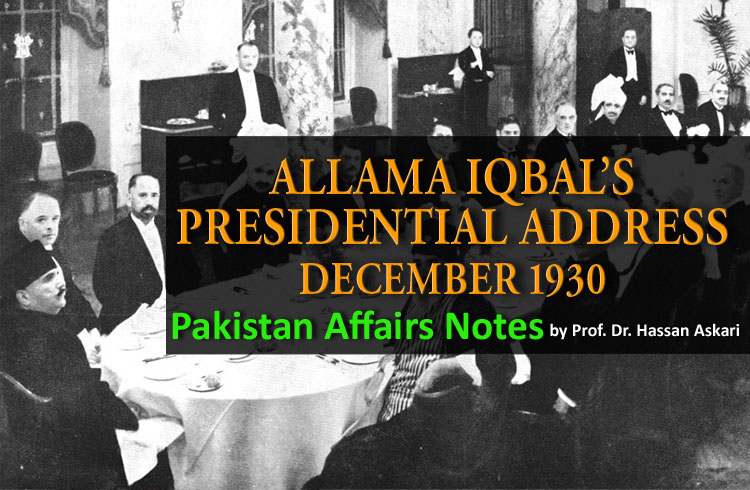
Dr Allama Muhammad Iqbal ranks amongst the Muslim intellectuals who left a deep impact on history. He inspired Muslims of the Sub-Continent and beyond. He infused a moving spirit and identity in the Indian Muslims. He presented a framework of their political future and talked how that would help to achieve the goal of Ummah. He presented a vision and dream in his Allahabad Address.

Background

The Hindu-Muslim question had great importance and stood crucial to British Indian history after 1857, especially in the 20th century. To Muslims, the key issue remained ‘separate identity.’ They tried their level best to make the rival nations understand that the Muslims are a separate nation having different culture and civilization, interests and rights. The Two Nations theory could not fascinate the Hindus and the British peoples because they believed in ‘territorial nationalism.’ The Hindus desired to absorb them in their majority but they could not face the arguments of the Muslim intellectuals. By 1930, Muslims had developed a sense of identity and political demands. Iqbal delivered his Presidential address in this background.

Categories
CSS Notes Pakistan Affairs Notes

Muslim Politics in British India: 1924-1935 | Pakistan Affairs Notes for CSS/PMS

Muslim Politics in British India: 1924-1935
Pakistan Affairs Notes for CSS/PMS

  1. Delhi Muslim Proposals
  2. Nehru Report
  3. Quaid-i-Azam’s Fourteen Points
  4. Simon Commission
  5. Round Table Conferences
  6. Constitutional Proposals

Backdrop:

The Khilafat movement brought Hindu-Muslim communities to cooperation. The leaders made the efforts to revive harmony for preparing constitutional proposals.

1: Delhi Muslim Proposals: March 1927

Categories
CSS Notes Pakistan Affairs Notes

The Khilafat Movement | Pakistan Affairs Notes for CSS/PMS

The Khilafat Movement

Pakistan Affairs Notes for CSS/PMS

The Khilafat movement was a religio-political movement launched by the Muslims of British India for the retention of the Ottoman Caliphate and for not handing over the control of Muslim holy places to non-Muslims.

Turkey sided with Germany in World War 1. As it began to lose the war, concerns were expressed in India about the future of Turkey. It was a peak period from 1919 to 1922 casting demonstrations, boycott, and other pressure by the two major communities, the Hindus and the Muslims. Being brothers, the Indian Muslims realized their religious duty to help the Muslim country. It was the extra territorial attachments based on Islam. Another factor same to the first was that the Indian Muslims considered Ottoman Caliphate a symbol of unity of the Muslim world as Ummah.

Categories
CSS Notes Pakistan Affairs Notes

Major Political Developments 1857-1918 | Pakistan Affairs Notes for CSS/PMS

Major Political Developments 1857-1918
Pakistan Affairs Notes for CSS/PMS

The year 1857 brought decline to the Muslim rule in India. Muslims and Hindus participated in the War of Independence but the British held only Muslims responsible for the rebellion. The Muslims were persecuted ruthlessly and left at the mercy of time. The post war era was disastrous for the Muslims but some personalities emerged on the national scene and played excellent role to guide their people in this critical situation. The Central Mohammedan Association of Justice Amir Ali Syed and the Aligarh movement are very prominent in this regard. Their efforts for revival of the self-identity and political positioning in the Indian society enabled them to face any challenge in the future.

Some important issues have already been discussed in the previous lectures. So a brief reference to events in historical context may be given: