Categories
Articles Current Affairs

Dismantled Kashmir (By: Dr. Zeeshan Khan)

The story of Distressed Kashmiris stirred again during Imran-Trump meeting in July this year. Trump talked about the Indian Prime Minister Modi offer about asking for the mediation over Kashmir. But in August, India imposes Kashmir lockdown, puts Kashmiri leaders ‘under house arrest’.Restrictions on movement and assembly imposed, Yatra Pilgrimage and mobile internet suspended as disputed region plunges into uncertainty.

The measures came after the Indian government moved 10,000 troops to the region last week, followed by an unprecedented order asking tourists and Hindu pilgrims to leave the Himalayan valley. Residents fear New Delhi has planned to engineer demographic changes.

The latest spate of tensions began after India sent 10,000 more troops to what is already one of the most militarised regions in the world.

Categories
Articles Current Affairs Pakistani Newspapers

Explainer: What India’s Change to Occupied Kashmir’s Status Means

India’s government has revoked the special constitutional status of Indian-occupied Kashmir (IoK), amid a heavy security crackdown in the disputed region.

The constitutional provision forbids Indians from outside the region from buying land or permanently settling in the Muslim-majority territory.

What is happening?

The Hindu nationalist-led government of Indian Prime Minister Narendra Modi on Monday proposed revoking Article 370 of India’s constitution, which confers special rights to permanent residents of IoK.

Categories
CSS Notes Pakistan Affairs

Sir Syed Ahmad Khan Was, In No Way, Pro-British (CSS Pakistan Affairs 2015)

Pakistan Affairs (CSS Paper 2015 )

Question: Sir Syed Alunad Khan was in no way pro-British”. Agree or disagree, answer your question with arguments


SOLUTION:

SIR SYED AHMAD KHAN WAS, IN NO WAY, PRO-BRITISH

“Sir Syed Ahmed was neither a politician nor a political leader. He was essentially a social reformer and his panacea for all the ills of his community were education.” Hafeez Malik

“Sir Syed was an ardent reformer and he wanted to reconcile modern scientific thought with religion by rationalistic interpretations and not by attacking basic belief. He was anxious to push new education. He was in no way communally separatist. Repeatedly he emphasised that religious differences should have no political and national significance”.
Jawaharlal Nehru, Former Prime Minister of India

Categories
CSS Optional subjects CSS Optional Subjects MCQs MCQs Solved CSS Past Papers

History of Indo-Pak CSS Paper 2013 (Solved MCQs) | Download in PDF

1. Which was the capital of Ummayyads at the time of Muhammad bin Qasim’s invasion?
(a) Baghdad
(b) Kufa
(c) Damascus
(d) None of these
Answer: (c)

2. Which city was named as the city of gold by Arabs during Bin Qasim’s invasion of Sindh?
(a) Debul
(b) Multan
(c) Brahman abad
(d) None of these
Answer: (b)

3. To which Silsila Sheikh Bahauddin Zakriya Multani belongs?
(a) Chishtiya
(b) Suharwardia
(c) Qadriya
(d) None of these
Answer: (b)

Categories
CSS Compulsory Subjects MCQs Current Affairs Current Affairs MCQs GK MCQ’s

Current Affairs MCQs Solved (July-August 2019) | Download in PDF

The scientists of which country have developed a statistical model that predict pollution levels using oceans’ memory?
(a) Pakistan/China
(b) China/USA
(c) France/UK
(d) USA/Germany
Answers: (b)

Which is the host country for the 2019 edition of World Hepatitis Day (WHD)?
(a) Pakistan
(b) India
(c) Bangladesh
(d) Sri Lanka
Answers: (a)

Ehsan Mani, who has been appointed chief of the ICC’s Finance & Commercial Affairs (F&CA), is from which country?
(a) Iran
(b) Pakistan
(c) India
(d) Saudi Arabia
Answers: (b)

Which Arab nation has recently launched its first Underwater Military Museum?
(a) Syria
(b) Oman
(c) Jordan
(d) UAE
Answers: (c)

Categories
CSS Compulsory Subjects MCQs Islamic Studies Islamic Studies MCQs MCQs

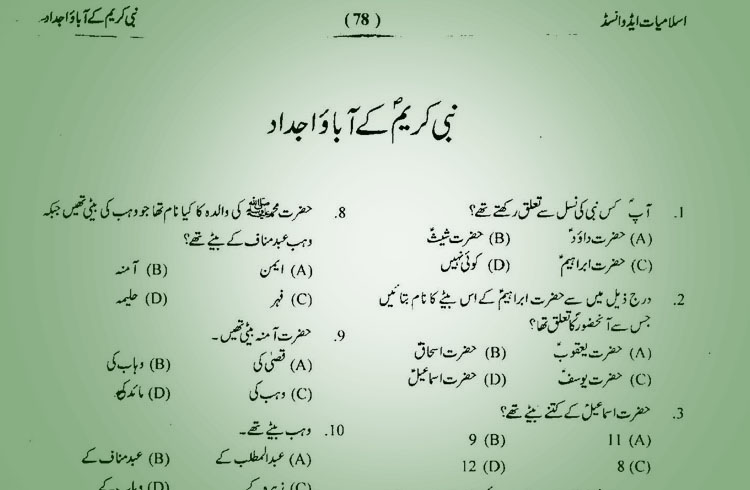
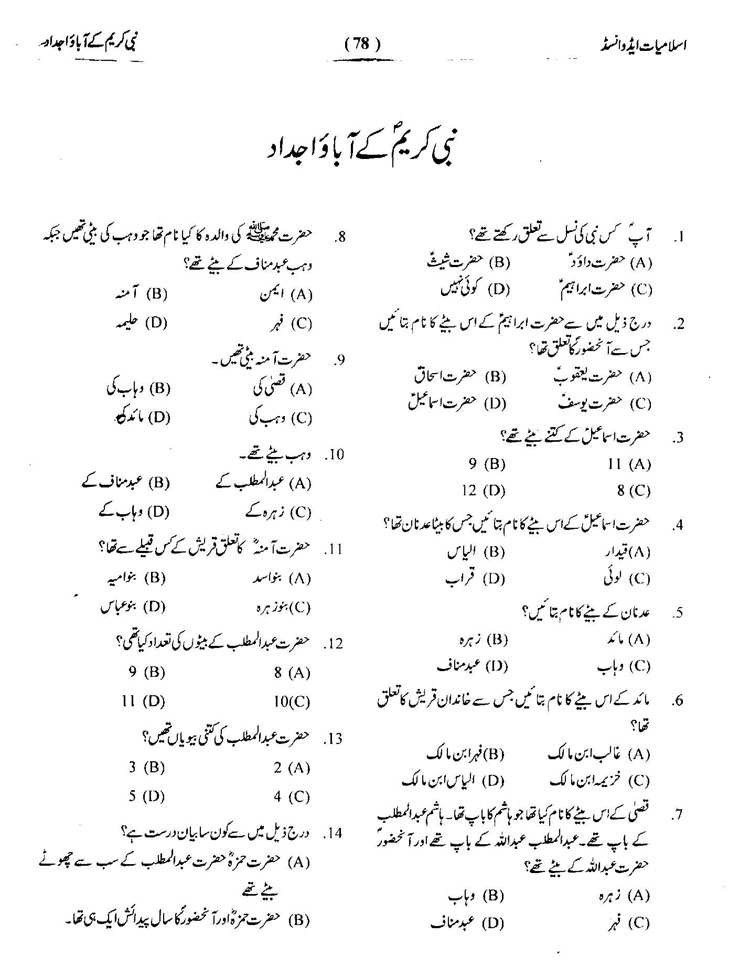
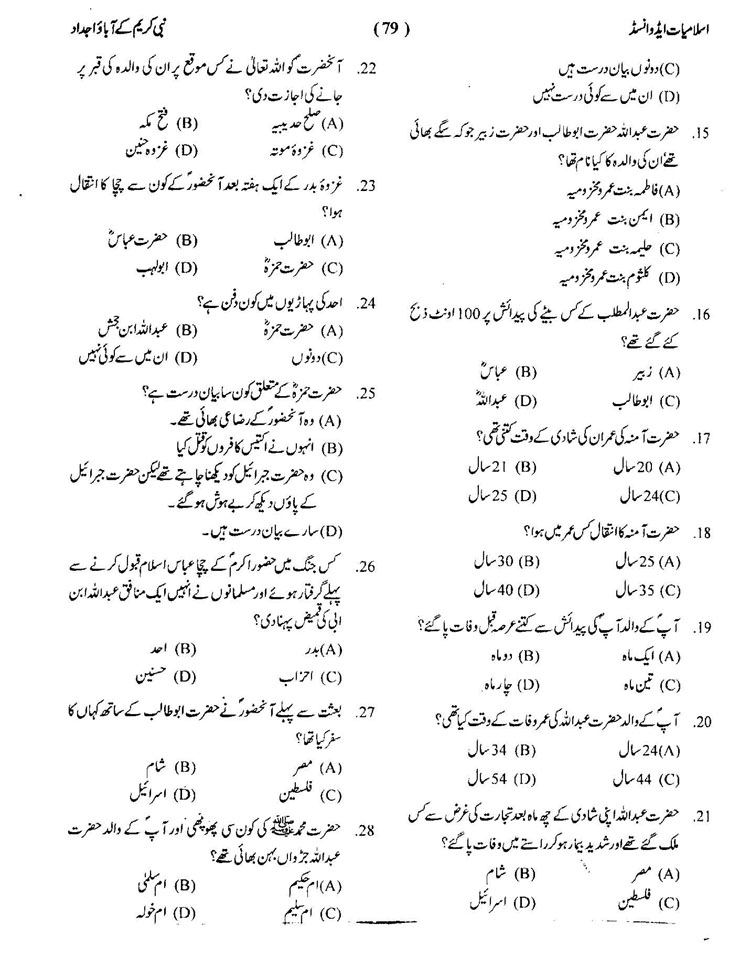
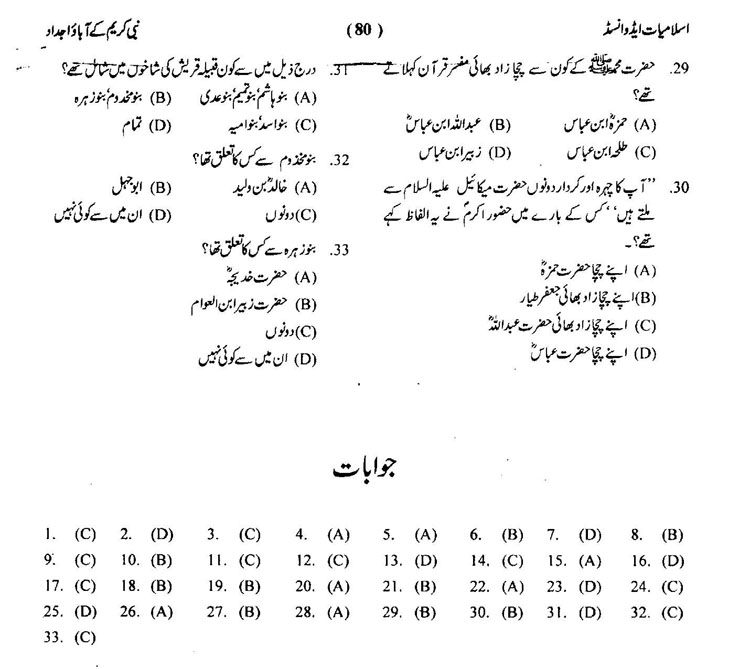
The Ancestors of Holy Prophet Muhammad (PBUH) | Islamiat MCQs for

All Important MCQs about the Ancestors of Holy Prophet (PBUH)

Islamiat MCQs for CSS, PMS, PCS, NTS, FPSC and all other relevant Competitive exams


The Ancestors of Holy Prophet Muhammad (PBUH) The Ancestors of Holy Prophet Muhammad (PBUH)The Ancestors of Holy Prophet Muhammad (PBUH)

Check Also Important CSS Islamiat MCQs

Categories
CSS Notes Islamic Studies

Seerah of Holy Prophet Muhammad (PBUH) As Diplomatic | CSS Islamic Studies Notes

The Holy Prophet (PBUH) is a role model for the mankind in all fields of life. He set the most perfect standards for the conduct of diplomats as well. All through his life, he was always conscious of maintaining cordial relations between Muslims and other communities. The Holy Prophet (PBUH), for the first time, came into contact with foreign world during his teenage when he went on a trade journey to Syria along with his uncle Hazrat Abu Talib. Then, during his youth he again went to Syria as a trade agent of Hazrat Khadijah (R.A). The Holy Prophet (PBUH) showed great attributes during these journeys. Hazrat Khadijah (R.A), a rich and highly influential businesswoman of that time, was so much impressed that she sent proposal for marriage to the Prophet (PBUH) that was accepted. This marriage had great impact on the life of the Prophet (PBUH) as it stabilized his financial status which enabled him to fully concentrate on propagation of Islam.

Categories
CSS Notes CSS Optional subjects

Origin of the Governance | (CSS Governance and Public Policy Notes)

Introduction

Like government, the word governance derives, ultimately, from the Greek verb (meaning to steer, the metaphorical sense first being attested in Plato). In above-described sense, however, the term governance was re-minted as recently as the 1990s by economists and political scientists, and disseminated by institutions such as the UN, IMF and World Bank. Its use in English can be traced to Charles Plummer’s ‘The Governance of England’ (published in 1885 as a translation from the original 13th century Latin of John Fortescue’s ‘The Difference between an Absolute and a Limited Monarchy’). This usage of governance to refer to the arrangements of governing became orthodox, including in Sidney Low’s seminal text of the same title in 1904 and among later British constitutional historians.

Different Uses

Governance is a very general concept that can refer to all manner of entities. Equally, this generality means that governance is often defined more narrowly to refer to a particular ‘level’ of governance associated with a type of organization (including public governance, global governance, non-profit governance, corporate governance, and project governance), a particular ‘field’ of governance associated with a type of activity or outcome (including environmental governance, internet governance, and information technology governance), or a particular ‘model’ of governance, often derived as an empirical or normative theory (including regulatory governance, participatory governance, multilevel governance, meta-governance, and collaborative governance). Governance can be used not only to describe these diverse topics but also to define normative or practical agendas for them. Normative concepts of fair governance or good governance are common among political, public sector, voluntary, and private sector organizations.
Categories
CSS Notes CSS Optional subjects

Governance Reforms in Pakistan | (CSS Governance and Public Policy Notes)

Governance Reforms in Pakistan
(CSS Governance and Public Policy Notes)

Introduction

Governance, Institutions and Development

The link between good governance and economic and social development has been well established in the last few decades. Although it is hard to have a precise definition of governance there is a wide consensus that good governance must lead to broad-based inclusive economic growth and social development. It must enable the state, the civil society and the private sector to enhance the well-being of a large segment of the population. If this definition is accepted, then economic growth in Pakistan is likely to become unsustainable if a widespread perception persists that the majority of the population has not been gaining from recent growth.  This perception, whether right or wrong, erodes political support for continuation of present economic policies and reforms.

Why does this perception persist?  The main reason is that the overall governance structure through which economics policies are intermediated and translated into economic and social benefits for the vast majority has become corroded and dysfunctional.   The governance structure of any country consists of Judiciary, Executive and Legislature.  If the access to the institutions of governance for common citizens is difficult, time consuming and costly the benefits from growth get distributed unevenly as only those who enjoy preferential access to these institutions are the gainers. How far is this true can be gauged by reference to the current state of Governance prevailing in the region but particularly applicable in Pakistan? The 1999 and 2005 reports on Human Development in South Asia aptly summarize the situation in the following two extracts:

Categories
Islamic Studies Islamic Studies MCQs MCQs

The Establishment of the First Islamic Empire | Islamiat MCQs

The Establishment of the First Islamic Empire | Islamiat MCQs 

For CSS, PCS, FPSC, NTS, OTS, PTS and all other related MCQs Exams and Tests