Categories
English Essay

Does Foreign Aid Help to Achieve Economic Stability? | Essay for CSS

Introduction

Foreign aid is the transfer of resources from developed countries to under-developed countries, either through bilateral donors or multilateral donors. Many countries in the world accept foreign assistance and get different benefits along with a few adverse results. The implication of foreign assistance has made it a debatable issue.

Meaning of Foreign Aid

Foreign aid is defined as the voluntary transfer of resources from one country to another country. This transfer includes any flow of capital to developing countries. A developing country usually does not have a robust industrial base and is characterized by a low Human Development Index (HDI).

Foreign aid can be in the form of a loan or a grant. It may be in either a soft or hard loan. This distinction means that if repayment of the aid requires foreign currency, then it is a hard loan. If it is in the home currency, then it’s a soft loan. The World Bank lends in hard loans, while the loans of its affiliates are soft loans.

The U.S. spends roughly $50.1B in foreign aid each year which is only 1.2% of the Federal government’s budget.

Who Gives Aid, and Who Receives It?

Historically most aid has been given as bilateral assistance directly from one country to another. Donors also provide aid indirectly as multilateral assistance, which pools resources together from many donors. The major multilateral institutions include the World Bank; the International Monetary Fund; the African, Asian, and Inter-American Development Banks, and various United Nations agencies such as the United Nations Development Programme.

Categories
International Relations International Relations MCQs MCQs

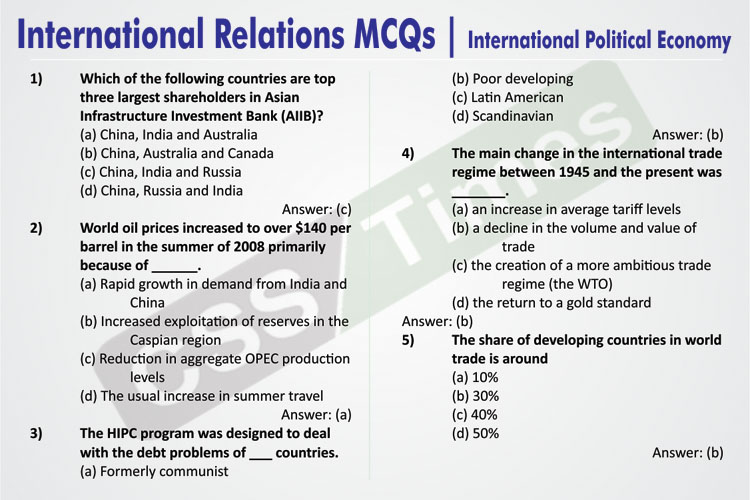
International Relations MCQs | International Political Economy

International Relations MCQs | International Political Economy

1) Which of the following countries are top three largest shareholders in Asian Infrastructure Investment Bank (AIIB)?
(a) China, India and Australia
(b) China, Australia and Canada
(c) China, India and Russia
(d) China, Russia and India
Answer: (c)

2) World oil prices increased to over $140 per barrel in the summer of 2008 primarily because of ______.
(a) Rapid growth in demand from India and China
(b) Increased exploitation of reserves in the Caspian region
(c) Reduction in aggregate OPEC production levels
(d) The usual increase in summer travel
Answer: (a)

3) The HIPC program was designed to deal with the debt problems of ___ countries.
(a) Formerly communist
(b) Poor developing
(c) Latin American
(d) Scandinavian
Answer: (b)

4) The main change in the international trade regime between 1945 and the present was _______.
(a) an increase in average tariff levels
(b) a decline in the volume and value of trade
(c) the creation of a more ambitious trade regime (the WTO)
(d) the return to a gold standard
Answer: (b)

5) The share of developing countries in world trade is around
(a) 10%
(b) 30%
(c) 40%
(d) 50%
Answer: (b)

Categories
CSS Notes General Science & Ability

Dark Matter and Dark Energy | General Science & Ability Notes

Dark Matter and Dark Energy

Q: Explain the terms Dark Energy and Dark Matter (CSS-2018)


 Dark Matter

In calculating the total mass-energy of the universe, astrophysicists find that baryonic matter, the type composed of atoms, accounts for only about 4 percent of the total mass-energy of the universe. The remaining 96 percent of mass is about 21 percent dark matter and 75 percent dark energy.

Dark matter has been impossible to investigate directly because it does not interact with electromagnetic radiation –visible light, infrared, etc. It has so far been identified only by its effects, especially its gravitational effects on galaxies and other large-scale entities, and also by its influence on the cosmic background radiation.

In the early universe, dark matter played a dominant role in the formation of the early galaxies. The cold gases in the universe gravitated to scattered dark matter densities. Where sufficient gas accumulated, star clusters and galaxies formed. Astronomers today maintain that each galaxy is enveloped in a halo of dark matter, and the halo applies so much force that the outside edge of a galaxy rotates about as fast as the deep interior. It is the halo of dark matter that prevents a galaxy from flying apart.

Categories
General Science & Ability General Science & Ability MCQs MCQs

Environmental Science MCQs | General Science & Ability MCQs

Environmental Science MCQs

General Science and Ability MCQs

Which of the following does not vary predictably with the depth of the aquatic environment? (CSS 2013)
(a) Salinity
(b) Temperature
(c) Penetration by sunlight
(d) None of these
Answer: (a)

The ozone layer protects the earth from rays sent by the sun: (CSS 2011)
(a) Ultraviolet rays
(b) Infrared rays
(c) Gamma rays
(d) Radioactive rays
(e) None of these
Answer: (a)

The ozone layer is present in atmosphere above earth. The stratum (layer) of atmosphere in which ozone layer lies is called as: (CSS 2011)
(a) Exosphere
(b) Mesosphere
(c) Stratosphere
(d) Ionosphere
(e) Troposphere
Answer: (c)

Categories
CSS Notes General Science & Ability

What do you know about the Milky Way? | General Science & Ability Notes

General Science & Ability Notes for CSS, PCS

Q: What do you know about the Milky Way? (CSS- 1987)


Solution:

Milky Way

The Milky Way, or simply the Galaxy, is the galaxy in which the Solar System is located. It is a barred spiral galaxy that is part of the Local Group of galaxies. It is one of billions of galaxies in the observable universe The Milky Way contains at least 100 billion stars and may have up to 400 billion stars. All the objects in the Milky Way Galaxy orbit their common center of mass, called the Galactic Center

Categories
CSS Compulsory Subjects MCQs General Science & Ability General Science & Ability MCQs

General Science MCQs | Concept of Producing BIO Fuel Method

General Science MCQs

Concept of Producing BIO Fuel Method

How is biofuel made?
(a) By fermenting the sugar components of starch crops
(b) By reacting vegetable oil or animal fat with an alcohol
(c) By treating plant oil or animal fat with hydrogen
(d) All of the above
Answer: (d)

Ethanol is biofuel and are known as
(a) carbon neutral
(b) hydrogen neutral
(c) oxygen neutral
(d) All of them
Answer: (a)

Propan-2-ol will get oxidized to give
(a) aldehyde
(b) ketone
(c) alcohol
(d) carbonyl
Answer: (b)

2 methyl-2 propan-2-ol is an example of
(a) primary alcohol
(b) secondary alcohol
(c) tertiary alcohol
(d) quaternary alcohol
Answer: (c)

Categories
CSS Notes General Science & Ability

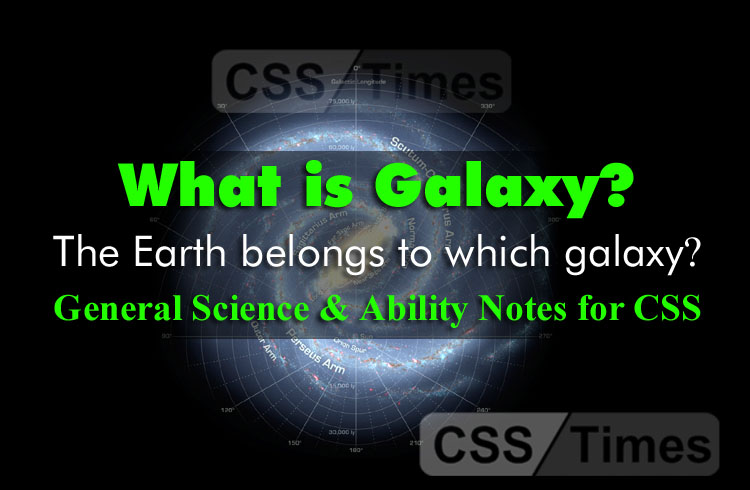
What is galaxy? The Earth belongs to which galaxy? | General Science & Ability Notes

Q: What is galaxy? The Earth belongs to which galaxy? (CSS 2011)

Galaxy

A galaxy is a large scale aggregate of stars, plus some gas, dust, and possibly. Solar systems, which are held together by gravity.

Early astronomers would look into the Universe with Their telescopes and notice “milky” areas that they could not be defined as one star. Sir William Herschel, in the late 1700’s, counted stars and recorded them, developed a notion of the Galaxy. The Galaxy referred to our own Milky Way with its billions of stars, with our Sun and planets being a component. Other galaxies were found throughout the Universe. These islands of stars had different shapes and sizes. The Andromeda Galaxy is spiral, and is larger than our Milky Way Galaxy.

Categories
CSS Notes General Science & Ability

What is Big Bang Theory | General Science & Ability Notes

Q: Briefly describe what is big bang theory. (CSS-2011)

The Big Bang

Once it was understood that the Universe had a beginning, scientists began to ask “how did it come into existence, and what existed before it?”

Most scientists now believe that the answer to the first part of the question is that the Universe sprang into existence from a singularity — a term physicists use to describe regions of space that defy the laws of physics. We know very little about singularities, but we believe that others probably exist in the cores of black holes.

Categories
CSS Notes General Science & Ability

Methods for Measuring the Age of the Universe | General Science & Ability Notes

Q: Describe different methods to estimate the age of the Universe (CSS-2018)

Methods for Measuring the Age of the Universe

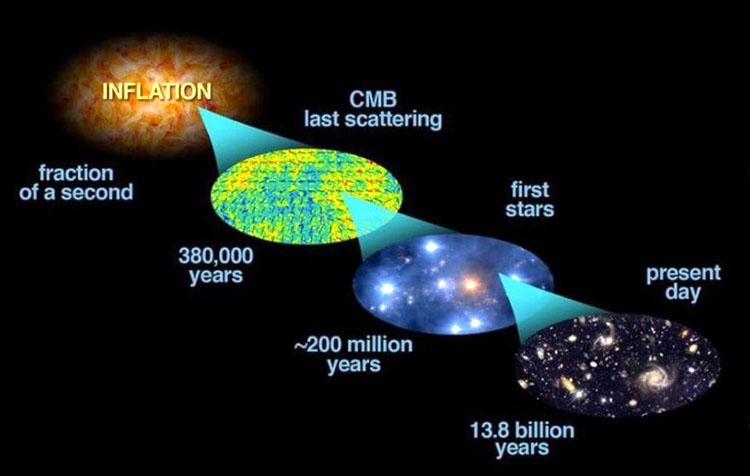
When we speak of “the age of the Universe,” we’re talking about how much time has past since the Universe could first be described by the hot Big Bang until the present day.

According to research, the universe is approximately 13.8 billion years old. How did scientists determine how many candles to put on the universe’s birthday cake? They can determine the age of the universe using two different methods:

1. Age of galaxies from the travel time of light
2. Age of the universe from expansion

Under the laws of General Relativity, if you have a Universe like ours, which is:


  • of uniform density on the largest scales,
  • which has the same laws and general properties at all locations,
  • which is the same in all directions, and
  • in which the Big Bang occurred at all locations everywhere at once, then there is a unique connection between how old the Universe is and how it’s expanded throughout its history.

In other words, if we can measure how the Universe is expanding today and how it has expanded throughout its entire history, we can know exactly what all the different components are that make it up. We learn this from a whole host of observations, including:

  • From direct measurements of the brightnesses and distances of objects in the Universe such as stars, galaxies and supernovae, allowing us to construct the cosmic distance ladder
  • From measurements of large-scale-structure, the clustering of galaxies, and from baryon acoustic oscillations
  • And from the fluctuations in the cosmic microwave background, a “snapshot” of the Universe when it was a mere 380,000 years old.

You put all of these things together, and you get a Universe that is made up, today, of 68% dark energy, 27% dark matter, 4.9% normal matter, about 0.1% neutrinos, about 0.01% radiation, and pretty much nothing else. But you throw in how the Universe is expanding today, and we can extrapolate this back in time, and learn the entire expansion history of the Universe, and hence, its age.

The number we get — most precisely from Planck but augmented from the other sources like supernova measurements, the HST key project and the Sloan Digital Sky Survey — is that the Universe is 13.81 billion years old, with an uncertainty of just 120 million years. This means we’re confident in the age of the Universe to 99.1% accuracy, which is an amazing feat!

If the Universe had the same current properties today but were made of 100% normal matter and no dark matter or dark energy, our Universe would be only 10 billion years old. If the Universe were 5% normal matter (with no dark matter or dark energy) and the Hubble constant were 50 km/s/Mpc instead of 70 km/s/Mpc, our Universe would be a whopping 16 billion years old. With the combinations of things we have today, however, we can confidently state 13.81 billion years is the age of the Universe, with a very small uncertainty. It’s an incredible feat of science.

Definition for Universe

The universe is defined as everything that exists, has existed, and will exist including all physical space, time, matter and energy, the planets, stars, galaxies, and the contents of intergalactic space The universe is currently estimated at roughly 13.7 billion years old, give or take 130 million years. In comparison, the solar system is only about 4.6 billion years old. This estimate came from measuring the composition of matter and energy density in the universe.

  • Astronomy is the science which investigates all the matter-energy in the universe: its distribution, composition, physical states, movements, and evolution. It is concerned with the evolution, physics, chemistry, meteorology, and motion of celestial objects, as well as the formation and development of the Universe. Astronomy is one of the oldest sciences
  • Cosmology: Astronomy also includes cosmology, which is the study of the structure, origin, and evolution of the universe. Cosmology is the branch of astronomy involving the origin and evolution of the universe, from the Big Bang to today and on into the future. According to NASA, the definition of cosmology is “the scientific study of the large scale properties of the universe as a whole.”
  • Astrology is not to be confused with Astronomy, which is a natural scientific study of celestial objects, such as stars, planets, comets, nebulae, star clusters and galaxies. Astrology is the study of the movements and relative positions of celestial bodies interpreted as having an influence on human affairs and the natural world. In other words, this consists of a number of belief systems which hold that there is a relationship between astronomical phenomena and events in the human world. If astrology is defined as a study does it make a science? No, many fields like philosophy or theology are defined as a study and are not sciences.

Evolution of Cosmolgical Theories

Cosmology is the study of universe as a whole, including its distant past and its future. It is the study of the general nature of the universe. What is the universe now? What was it in the past and what is it likely to be in the future? How was the universe created? These are the basic themes of cosmology. Men have been examining and wondering about the sky for many millennia. As scientific discoveries have been made, ideas about the origin of the universe have changed and are still changing

Ptolemy’s Geocentric Theory

A Geocentric theory is an astronomical theory which describes the universe as a geocentric system, i.e., a system which puts the Earth in the center of the universe, and describes other objects from the point of view of the Earth. Ptolemy proposed his geocentric theory in the 2nd century A.D. According to his theory, the earth stood at the center, surrounded by some eight spheres, the Moon, the Sun, the stars, and the five other planets known till the time: Mercury, Venus, Mars, Jupiter, and Saturn.

The geocentric theory was considered to be profoundly mistaken at that time. Since the advent of relativity theory in the early 1900s, the laws of physics have been written in covariant equations, meaning that they are equally valid in any frame. Heliocentric and geocentric plotting systems are both used today, depending on which allows more convenient calculations.

Sun centered Universe (Heliocentric Theory)

In the early 1500s, when virtually everyone believed Earth was the center of the universe, Polish scientist Nicolaus Copernicus proposed that the planets instead revolved around the sun. Although his model wasn’t completely correct, it formed a strong foundation for future scientists to build on and improve mankind’s understanding of the motion of heavenly bodies.

Copernicus’ ideas, published only two months before he died, took nearly a hundred years to seriously take hold. When Galileo Galilei claimed in 1632 that Earth orbited the sun, building upon the Polish astronomer’s work, he found himself under house arrest for committing heresy against the Catholic Church

Despite this, the observations of the universe proved the two men correct in their understanding of the motion of celestial bodies. Today, we call the model of the solar system, in which the planets orbit the sun, a heliocentric or Copernican model.

Origion of the Universe

In 1959 a survey was conducted of scientists across America concerning their understanding of the physical sciences. One particular question asked “What is your concept of the age of the Universe?” More than two thirds of the scientists polled responded that there was no origin of the Universe. They believed that the Universe was eternal.

Then five years later, in 1964, radio astronomers Arno Penzias and Robert Wilson discovered a microwave signal buried in their data. They attempted to filter out the signal, assuming that it was merely unwanted noise. However, they soon realized what the signal actually was; they had inadvertently discovered the Cosmic Microwave Background (CMB). The CMB had been predicted by a theory that few believed at the time called the Big Bang. This discovery was the first evidence that the Universe had a beginning

Categories
CSS Notes Pakistan Affairs

Judicial Activism in Pakistan | CSS Pakistan Affairs Notes

Judicial Activism in Pakistan | CSS Pakistan Affairs Notes

Pakistan has had five constitutions in its seventy years history, of which four were indigenous. It has had fourteen different constitutional patterns formed since 1947 and had been governed under a suspended, modified constitution and restored constitutions. From 1999-2008, the state was governed under various legal devices including two Provisional Constitutional Orders (PCO) and a Legal Framework Order (LFO) while the Constitution was also amended in a significant way through the 17th Amendment. But in 2007, General Musharraf took an ill -advised step of suspending the Supreme Court (SC) Chief Justice who was reinstated by the court, while the next step of changing the Courts’ composition through the PCO eventually led Musharraf to leave power in August 2008. The dismissed judges were restored in March 2009 and in April 2010; the parliament passed the 18th Amendment restoring the constitution to a Prime Ministerial form of government.

The history of superior courts’ decisions had a direct bearing on the constitutional structure or the system and model for Pakistan’s judicial experience.