Categories
Constitutional Law CSS Tips

What is Constitutional Law? | CSS Constitutional Law Notes

Definition and Scope of Constitutional Law

What is Constitutional Law?

  1. That branch of the public law of a state which treats of the organization and frame of government, the organs and powers of sovereignty the distribution of political and governmental authorities and functions, the fundamental principles which are to regulate the relations of government and subject, and which prescribes generally the plan and method according to which the public affairs of the state are to be administered.
  2. That department of the science of law which treats of constitutions, their establishment, construction and interpretation and of the validity of legal enactments as tested by the criterion of conformity to the fundamental law.
  3. A constitutional law is one which is consonant to, and agrees with, the constitution: one which is not in violation of any provision of the constitution of the particular state

Constitutional law is a type of public law that revolves solely around the distribution and exercise of government power. In the United States, the constitution is in essence, the framework for which all laws are established and to specify the separation of powers between the three branches (judicial, legislative and executive) of the federal government.

That being said, not all nation states possess a codified constitution. Those that do not; however, will typically utilize some form of law of the land that may consist of a number of consensual rules. These may include international rules on train, the separation of church and state, laws governing governmental powers, various statutory laws, customary law conventions, judge-made laws and an assortment of other frameworks.
Categories
General Science & Ability

Energy Resources MCQs (Set-II) | General Science and Ability

One major reason for the lack of development in oceanic energy sources is ________.
(a) The potential substantial negative impact on marine and estuarine ecosystems
(b) The lack of funding
(c) That oceanic processes are not completely understood
(d) The lack of technological advancement
(e) The lack of political support
Answer: (a)

The largest problem with adopting the new technology of renewable resources is ________.
(a) in evaluating the scientific and economic impacts
(b) that the startup costs are high
(c) that long term maintenance costs are higher than those for fossil fuels
(d) that technological advances have not been made in the last 30 years to meet our energy needs
(e) that energy production facilities are not located near consumers
Answer: (b)

Although solar-PV-generated electricity as a power source is cleaner than burning fossil fuels, the problem with this electricity is that it ________.
(a) is dangerous if stored too long
(b) cannot be stored easily in large quantities for use when and where it is needed
(c) is not sufficiently understood
(d) will be replaced shortly with other sources of power for homes
(e) is less efficient than fossil fuels
Answer: (b)

One difficulty with the process of using hydrogen as a power source is that it ________.
(a) is not properly understood
(b) is less efficient than fossil fuels
(c) requires a fuel that is a nonrenewable resource
(d) requires an energy investment to begin the process
(e) has highly volatile and dangerous components
Answer: (d)

Categories
General Science & Ability

Energy Resources MCQs (Set-I) | General Science and Ability

Which of the following is a non-renewable resource?
(a) Coal
(b) Forests
(c) Water
(d) Wildlife
Answer: (a)

Which among the following is not a renewable source of energy?
(a) Solar energy
(b) Biomass energy
(c) Hydro-power
(d) Geothermal energy
Answer: (b)

Identify the non-renewable energy resource from the following:
(a) Coal
(b) Fuel cells
(c) Wind power
(d) Wave power
Answer: (a)

Which of the following is a disadvantage of most of the renewable energy sources?
(a) Highly polluting
(b) High waste disposal cost
(c) Unreliable supply
(d) High running cost
Answer: (c)

Photovoltaic energy is the conversion of sunlight into:
(a) Chemical energy
(b) Biogas
(c) Electricity
(d) Geothermal energy
Answer: (a)

Categories
English Essay Essays Outlines

Essay Outline: Impacts of Climate Change on Pakistan as One of the Worst Hit Regions

Essay Outline: Impacts of Climate Change on Pakistan as One of the Worst Hit Regions

1. Introduction

1.1 Climate change has affected all regions of the world due to the man-made activities which contribute to greenhouse gases.
1.2 Climate change has affected the most vulnerable regions by posing threat to the lives of living beings, polluting the environment and damaging the agriculture.

2. How vulnerable is the world due to climate change

2.1 Melting of glaciers has resulted in the rising of sea levels.
2.2 Less rainfall has resulted in droughts, famines and epidemics.i.e; Thar in Pakistan.

Categories
GK MCQ’s MCQs Pakistan Affairs Pakistan Affairs MCQs Pakistan Studies MCQs

The Constitution of 1962 | Important MCQs for Pakistan Studies

President M. Ayub Khan implemented the 1962 constitution on ____.
(a) 18 April 1960
(b) 12 March 1962
(c) 14 August 1964
(d) 8 June 1962
Answer: d

The constitution of 1962 had ____ articles.
(a) 240
(b) 250
(c) 260
(d) 270
Answer: b

It had ____ parts.
(a) 12
(b) 14
(c) 16
(d) 18
Answer: a

Categories
English Essay Essays Outlines

Essay Outline: Disturbed Borders Suggest Unending Wars and Threats to Human Lives

Essay Outline: Disturbed Borders Suggest Unending Wars and Threats to Human Lives

1. Introduction

1.1 Border skirmishes lead to antagonism
1.2 Bloodshed over the borders poisons the relationship among countries.

2. Why do borders remain disturbed?

2.1 Unspecified demarcation of borders lead to antagonism among countries.
2.2 Cross-border terrorism and proxy wars result in retaliation.
2.3 Economic inequalities among countries. i.e; India-Pak over water.
2.4 Historical rivalries among countries. i.e; Pak-Afghan Durand line.
2.5 Civil warsi.e; Yemen, Syria

Categories
GK MCQ’s MCQs Pakistan Affairs Pakistan Affairs MCQs Pakistan Studies MCQs

The Constitution of 1956 | Important MCQs for Pakistan Studies

The first Constitution of 1956 was enforced on 23rd March, ____.
(a) 1956
(b) 1957
(c) 1958
(d) None of these
Answer: a

____ are the total Articles of 1956 Constitution.
(a) 230
(b) 232
(c) 234
(d) 236
Answer: c

There are ____ parts of Constitution.
(a) 11
(b) 13
(c) 15
(d) 17
Answer: b

Categories
MCQs Pakistan Affairs Pakistan Affairs MCQs Pakistan Studies MCQs

Pakistan Affairs MCQs | Important Constitutional Development

In the Constituent Assembly, there were two parties, Muslim League representing the Muslims and ____ party representing Hindus in Pakistan.
(a) Unionist
(b) Congress
(c) Nationalist
(d) Fundamentalist
Answer: b

____ was the first Prime Minister of Pakistan.
(a) Liaquat Ali Khan
(b) Khawaja Nizamuddin
(c) Quaid-e-Azam
(d) I.I Chundrigar
Answer: a

The Objective Resolution was presented in Assembly by ____.
(a) Khawaja Nazimuddin
(b) Liaquat Ali Khan
(c) Ghulam Muhammad
(d) Ayub Khan
Answer: b

Categories
English Essay Essays Outlines

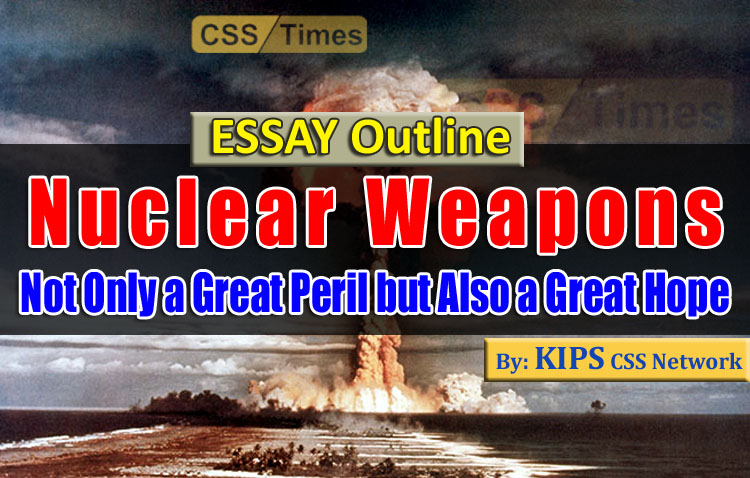
Essay Outline: Nuclear Weapons are Not Only a Great Peril but Also a Great Hope

Essay Outline: Nuclear Weapons are Not Only a Great Peril but Also a Great Hope

1. Introduction

1.1 Nuclear weapons are the weapons of mass destruction that engulf the whole region into fumes.
1.2 Nuclear weapons besides endangering human lives and infrastructures also give a hope for a country to survive through deterrence.
1.3 Historical overview of nuclear weapons as great peril
a) Mass destructions of cities in Japan, WWII. i.e; Hiroshima and Nagasaki.
b) Spreading of cancer diseases that continued for generations due to the radiations of nuclear weapons.
c) Explosion of nuclear reactors. i.e; Chernobyl incident, Fukushima incident – led thousands of people to evacuate from their places.

Categories
CSS Compulsory Subjects MCQs Pakistan Affairs Pakistan Affairs MCQs Pakistan Studies MCQs

Pakistan Studies/Affairs: Most Important MCQs (Set V) for CSS, PMS, PCS, NTS

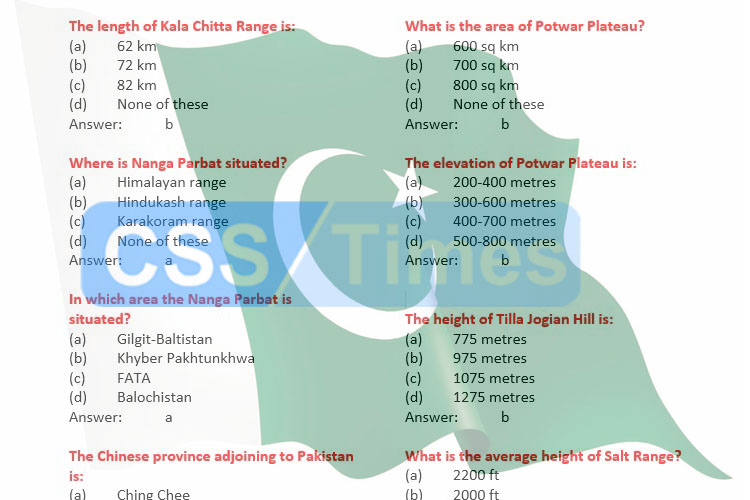
The length of Kala Chitta Range is:
(a) 62 km
(b) 72 km
(c) 82 km
(d) None of these
Answer: b

Where is Nanga Parbat situated?
(a) Himalayan range
(b) Hindukash range
(c) Karakoram range
(d) None of these
Answer: a

In which area the Nanga Parbat is situated?
(a) Gilgit-Baltistan
(b) Khyber Pakhtunkhwa
(c) FATA
(d) Balochistan
Answer: a

The Chinese province adjoining to Pakistan is:
(a) Ching Chee
(b) Sinkiang
(c) Minking
(d) None of these
Answer: b